.
________________________________________________________________
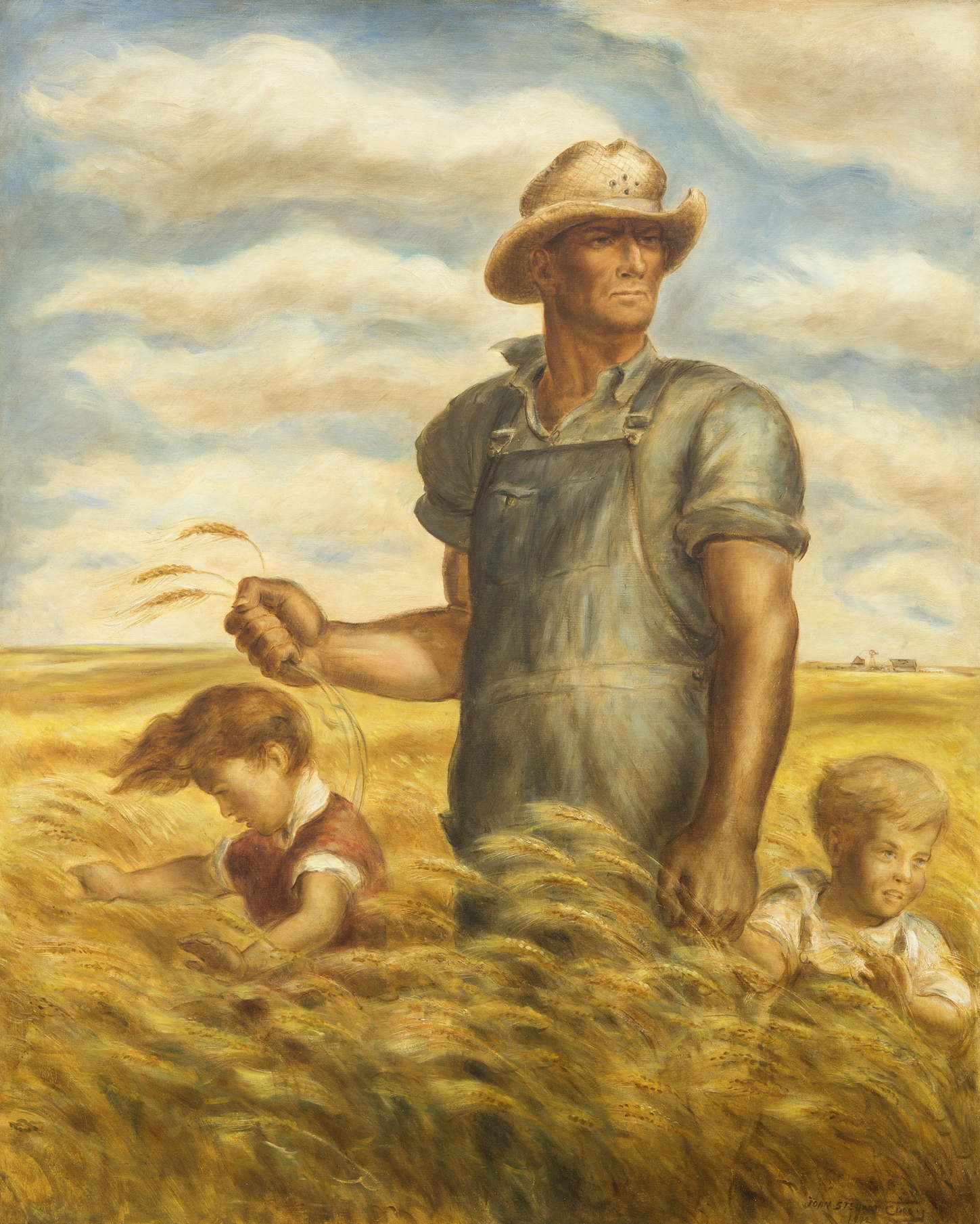
Précis: Scholars have proposed that the central figure in John Steuart Curry’s Our Good Earth is based on a representation of Adam by Dürer or of David by Michelangelo. In this essay the author questions those theories and argues the source for the commanding figure was Millet’s The Sower. Curry’s decision to reference Millet provides not only compositional strength but thematic depth to this quintessentially American work.
________________________________________________________________
.
FIGURE 1
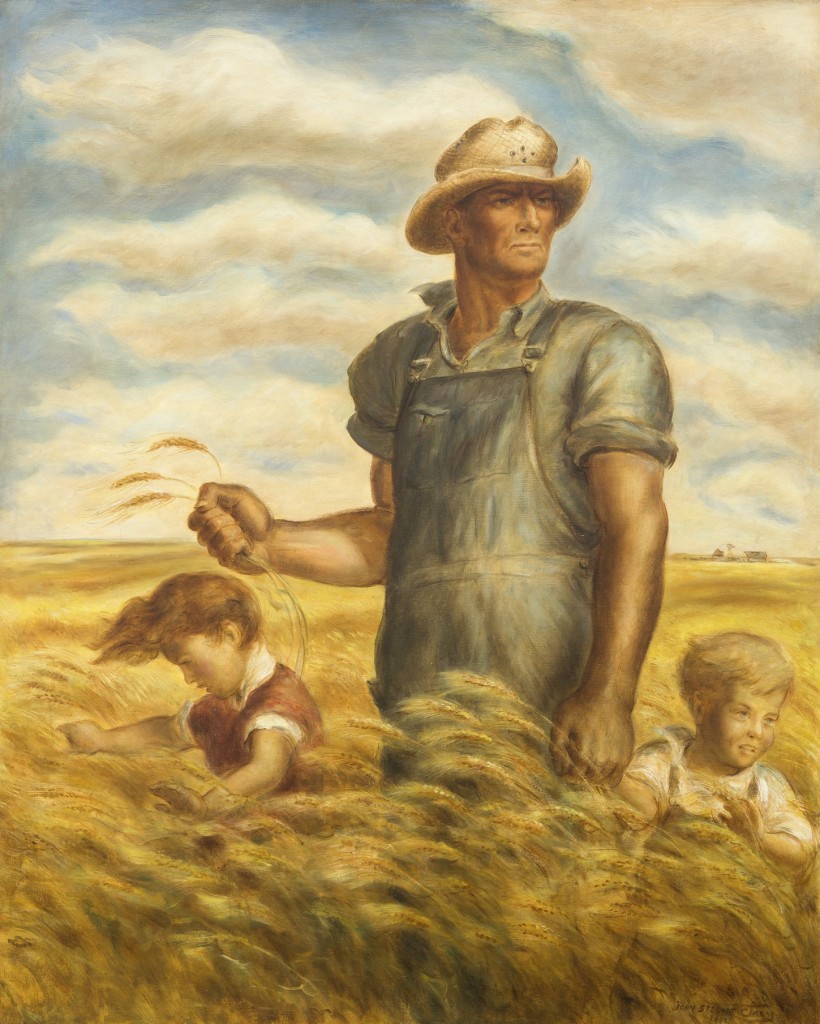
John Steuart Curry, Our Good Earth (1942), oil on hardboard, 60 1/8 x 48 1/8 in., Chazen Museum of Art at the University of Wisconsin, on loan from the College of Agricultural and Life Sciences, Gift of the U.S. Treasury Department to the College of Agriculture
.
I. Introduction
The most recent museum survey of the work of American artist John Steuart Curry (1897-1946) took place 15 years ago. [1] The title of that exhibition, John Steuart Curry: Inventing the Middle West, assigned to the artist the formidable challenge of creating, through art, a durable image of the American heartland. Did Curry live up to that challenge? Though his career was tragically abbreviated, I believe Curry acquitted himself well in that task. This was especially true when his works of “invention” were informed by tradition.
My favorite image created by Curry — one that bears traces of his study of his predecessors in art history — is a work called Our Good Earth. It was a commissioned picture, made for a federal government project at the start of World War II. The aim of the project was to inspire leading American artists to create pictures that would encourage popular support for the nation’s war effort. [2] Curry’s response was simple yet powerful, an image that transcends its original motivation as illustration and propaganda. He created what one commentator, decades later, described as “a representation of the contemporary yeoman farmer descended from those who founded and developed this country; his placement in a field of waving wheat surrounded by his children presents the Midwest as an energetic, fertile land, inhabited by heroic people of unlimited potential.” [3]
II. The Image and its Progeny
Our Good Earth exists in several forms and formats. There is a finished oil painting (fig. 1), to which I’ve given pride of place at the beginning of this essay. The painting was used as the basis for a photo-mechanical color lithographic war poster, produced by the U.S. Government Printing Office (GPO) in both a large version (fig. 2) and smaller versions. Copies of these were distributed and posted nationwide. The image was used again as a cover illustration for a GPO informational booklet directed to farmers. It appeared once more as a fine art lithograph on stone (fig. 3) published in 1942 in an edition of 250 by Associated American Artists. Perhaps because of its approachable size and the ability of the graphic medium to reveal the hand of the artist, the lithograph is in my opinion the most evocative version. [4]
.
FIGURE 2
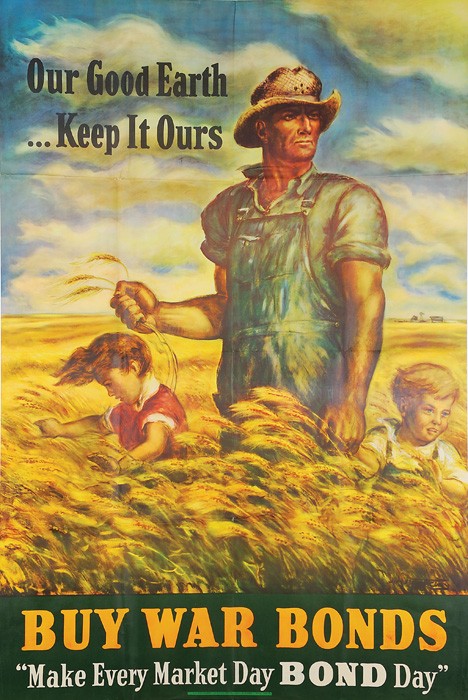
Our Good Earth … Keep It Ours, signed and dated in the plate, 1942, photo-mechanical color lithograph, 59 3/4 x 39 1/2 in. Printing Office U.S. Government Printing Office: 1942-O-472519 WSS 509-B
.
FIGURE 3
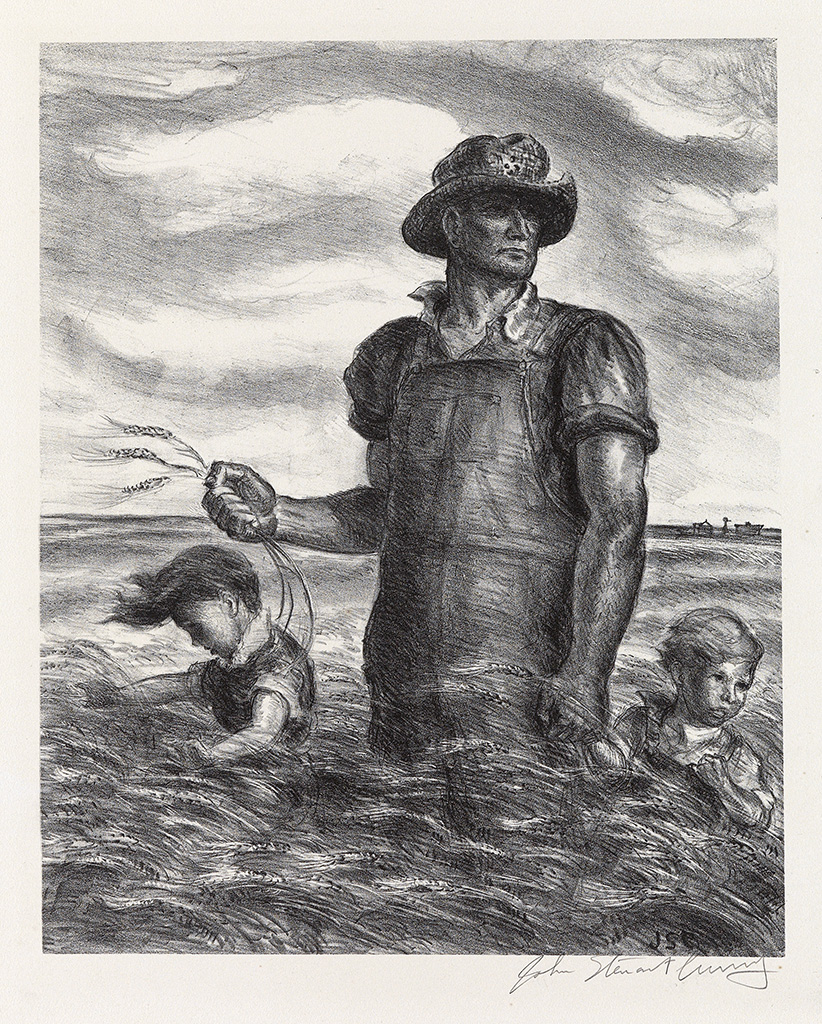
Our Good Earth, 1942. Lithograph, Cole 36. 12 3/4 x 10 1/8 (sheet: 16 3/4 x 12 5/8). Edition of 250 published by Associated American Artists.
.
III. Speculation about the Source of the Image
Some observers have speculated about the originality of the composition. Was Our Good Earth an entirely home-grown image? Or was it largely patterned upon or at least inspired by prior achievements of other artists?
Two art scholars contend the work is not an entirely new conception. They assert Curry was not only inspired by, but also borrowed heavily from, other works of art. Interestingly — and I believe to the disservice of their arguments — both commentators do not consider the composition as a whole. Instead, their exclusive focus is on the central figure of the farmer.
One of these art historians is Robert L. Gambone. In “The Use of Religious Motifs in Curry’s Art,” an essay he contributed to the 1998 Curry exhibition catalogue, Gambone argues that the artist’s source for the farmer is to be found in the figure of Adam in a 1504 engraving, Adam and Eve (fig. 4), by Albrecht Dürer. [5]
.
FIGURE 4
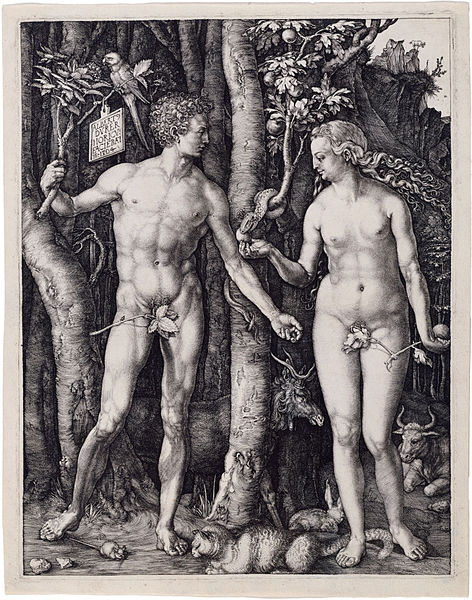 Adam and Eve, 1504
Albrecht Dürer (German, 1471–1528)
Engraving; 9 7/8 x 7 7/8 in. (25.1 x 20 cm)
.
Gambone writes:
“Once America entered the war, Curry attempted to rally to the cause, reworking a 1938 lithograph into a painting entitled Our Good Earth for a U.S. Department of the Treasury propaganda poster. In it, a muscular young farmer stands in a wheat field, two children playing at his side. […] The farmer’s noble form recalls idealized images of Renaissance humanism and, by implication, the optimistic understanding of human nature implicit in Renaissance art. Specifically, the figure recalls Adam in Albrecht Dürer’s engraving Adam and Eve (1504). Although Curry reverses the pose and places the left arm closer to the body, the turn of the farmer’s head, his flexed right arm holding the agricultural produce, and his massive upper body all stem from Dürer. […] Curry’s source in Dürer is significant.”[6]
There are, however, many problems with the theory that Curry’s farmer is copied from Dürer’s Adam.
It is telling that Gambone cites no writings or other archival evidence from Curry or from the artist’s circle, that would confirm his speculation. While Gambone’s essay includes a healthy section of footnotes expanding on other points made in course of a wide-ranging look at the religious content of the artist’s oeuvre, his particular analysis of Our Good Earth is devoid of any supporting information.
But the problem goes beyond the lack of foundation. When one closely examines Dürer’s engraving, the purported similarity between Curry’s farmer and Adam dissolves, leaving only an imagined construct. There is, for example, the inconvenient fact that the Midwesterner’s left and right arms more closely mimic the arms of Eve than of Adam. There is the awkward fact that the immobile, totemic stance of the farmer, his two legs squarely anchored in the land, defying a buffeting wind, is the antithesis of Adam’s pliant posture. Adam’s right leg is bent at the knee and his heal lifts off the turf, an action that shifts his weight to be borne almost entirely by his left leg. We see how Dürer’s delight in S-curves imparts a supple, balletic grace to the pose. Adam is poised and ready to move. The farmer? He will stand his ground.
Notice also how we, the viewer, meet Adam’s visage flat on, face-to-face, on his level (we are him, after all). In contrast, the viewer looks up to meet the farmer’s countenance, a viewer-to-figure relationship Curry used most famously in his mural and lithograph depicting John Brown (he is to be elevated, if not mythologized). Significant as well is that the depiction of the farmer is of a piece with the body of Curry’s work. When considered in relationship to all of Curry’s figurative pieces, the treatment here proves to be simply another instance of the solid figuration the artist routinely adopted when depicting working men, whether they were farmers, a plainsman, a college administrator, athletes on the gridiron, or aerialists under a circus tent. [6B]
Curry did not have to reach across four centuries and an ocean to find a model for his farmer. One was much closer to home, literally. The stalwart body (or, to be more Kansas-colloquial, the “stocky” body) that Curry chose for his farmer belongs to his father, Smith Curry. [7] Here is The Stockman (fig. 5), one of several portraits the artist painted of a man his son always looked up to [8]:
.
FIGURE 5
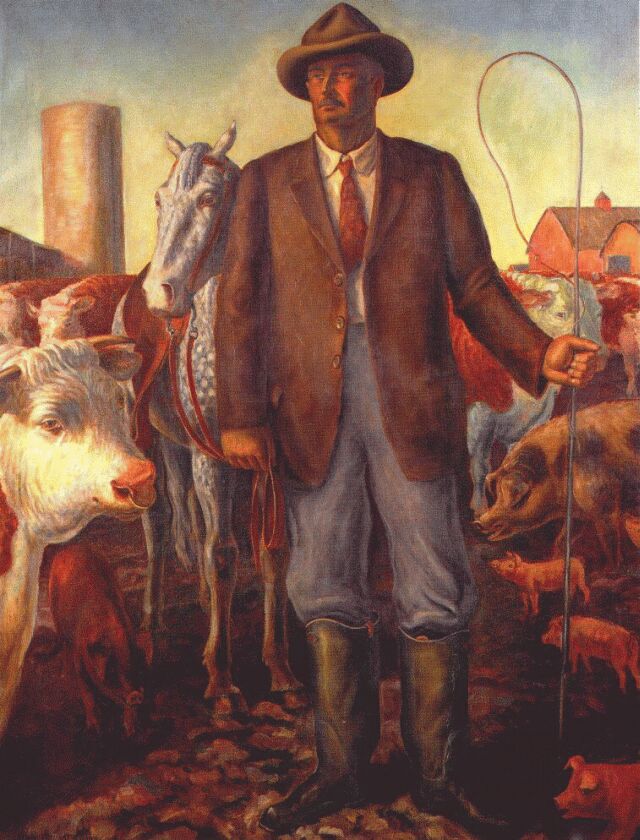 The Stockman, 1929, oil on canvas, 52 x 40 in., signed lower left: JOHN STEUART CURRY, collection of the Whitney Museum of Art, NY
.
For me the key passage in Our Good Earth is the gesture formed by the farmer’s right arm (fig. 6). The arm is bent at the elbow, the forearm projects laterally, and the fingers of the hand curl into a purposeful fist.
.
FIGURE 6
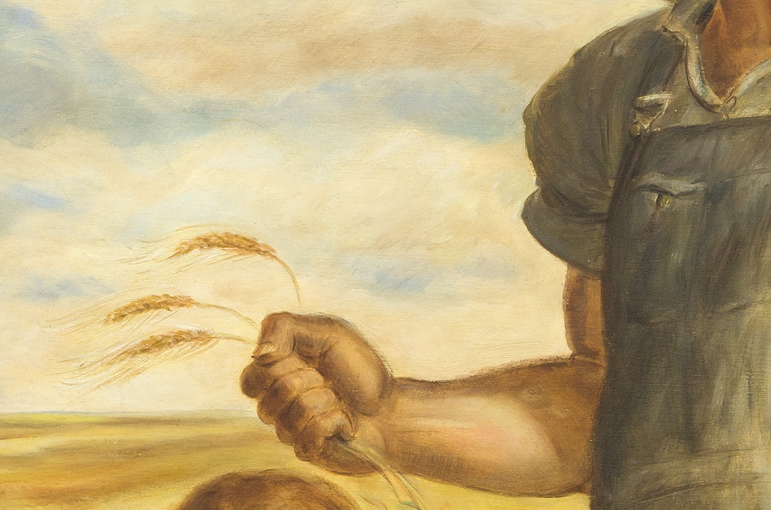
Detail of Our Good Earth (painting)
.
The fist clutches three stalks of wheat whose structure, on closer inspection, assumes the form of a handle ending in a tuft, a structure it shares with many utilitarian objects. [9] Why did Curry introduce this element to the picture?
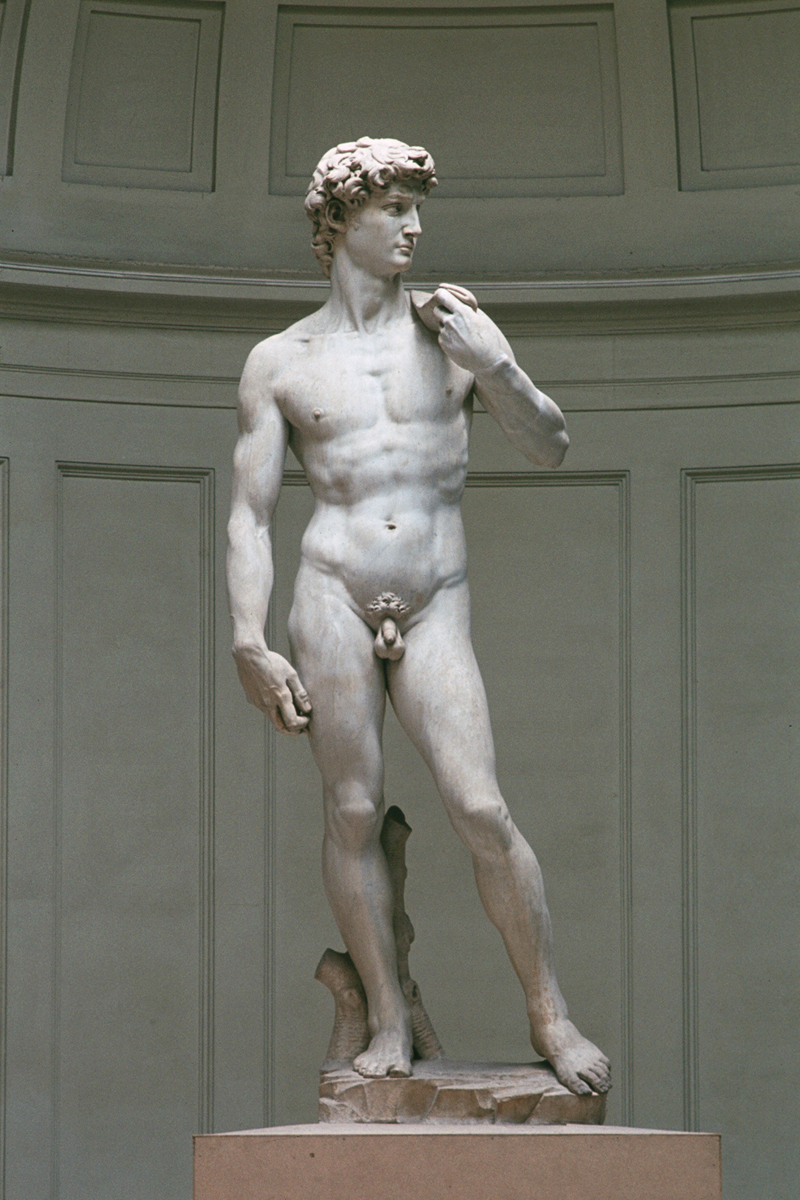
Gambone supposes that Curry was copying the hand of Dürer’s Adam who grasps “agricultural produce.” But a second art scholar who looked at the same detail, Bill North, disagrees. North’s examination led him to propose the “likely source” for the farmer was Michelangelo’s sculpture of David (fig. 7).
.
FIGURE 7
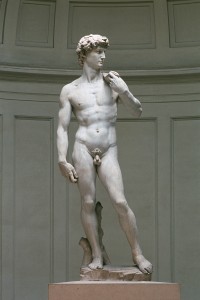
Michelangelo, David
.
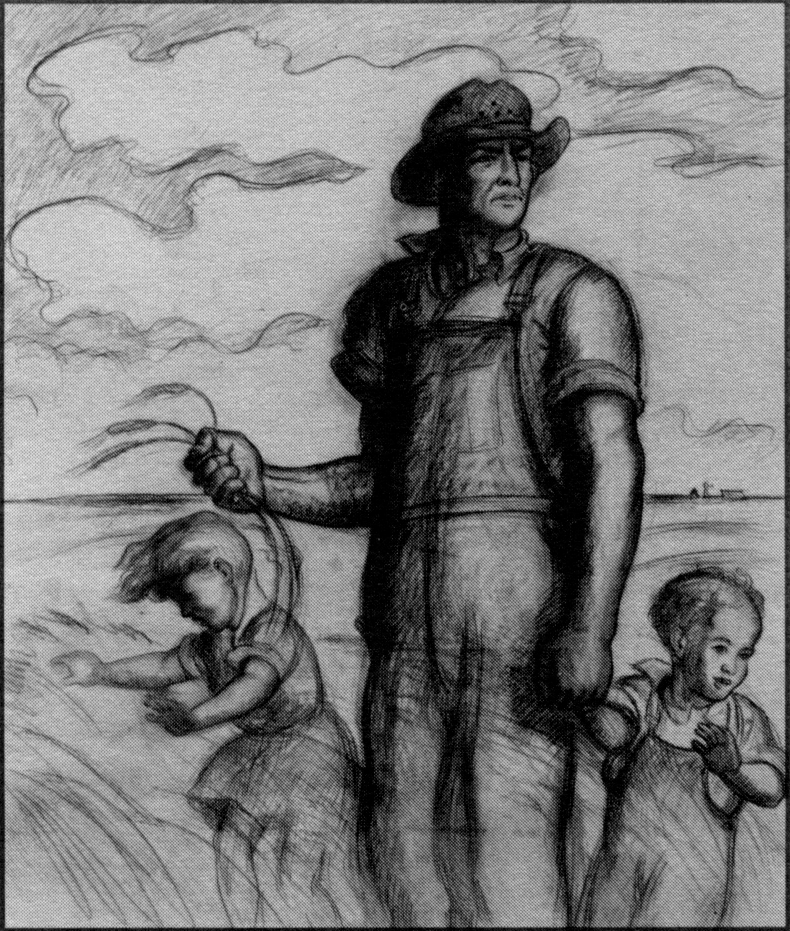
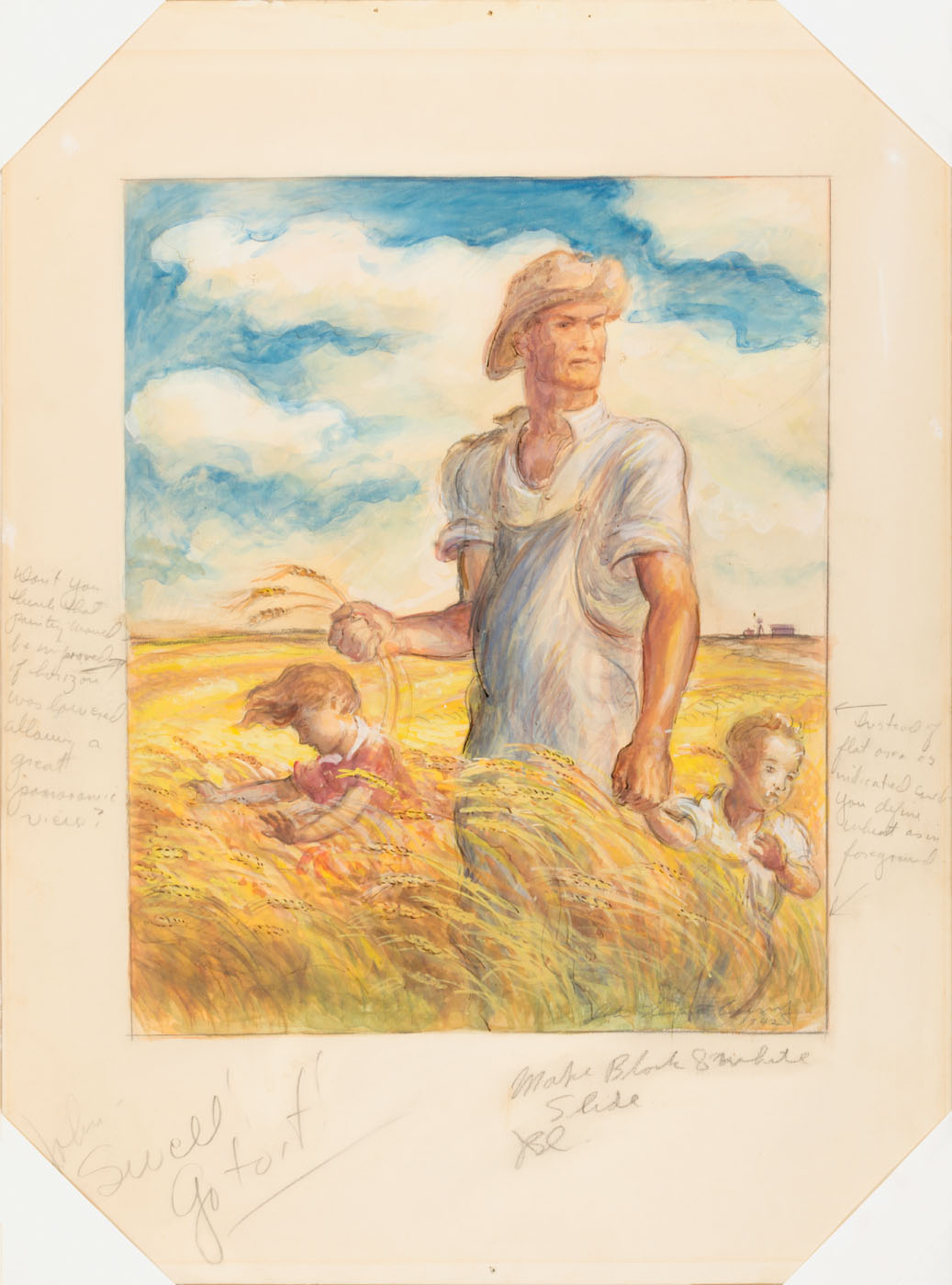
In the catalog he edited for a 1997-1998 exhibition of the paintings of Kansas Regionalist William Dickerson at the Beach Museum of Art (Kansas State University), North examined a preliminary drawing for Our Good Earth {fig. 8} and came to the following conclusion:
“Curry, like Thomas Hart Benton and Grant Wood (the other two members of the Regionalist Triumvirate), was not adverse to coopting and transposing European examples. Michelangelo’s David seems the likely source for Curry’s heroic farmer, who, instead of holding a sling, is seen clutching three stems of wheat, possible a reference to Curry, Benton, and Wood, and, by extension, to the use of their art as a weapon.” [10]
FIGURE 8
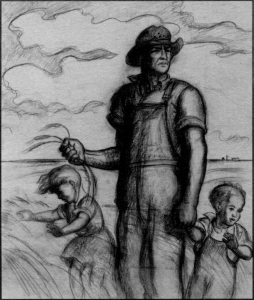 John Stuart Curry, Study for Our Good Earth, ca. 1942, black crayon with white chalk on paper, 62 3/4 x 50 1/2. Kansas State University, Beach Museum of Art, Gift of Don Lambert, 1996.19
.
I believe both the Adam and David theories are based on a misreading of the visual evidence.
While the pose of Adam may borrow cues from David, both poses are essentially at odds with that of Curry’s farmer. In the search for clues to the source of Our Good Earth, a hand holding “agricultural produce” and a hand holding a sling are red herrings. When Curry sought a signifier of virility and accomplishment that would be central to his picture, he did not have to turn to Dürer or Michelangelo. Inspiration and a model were, literally, closer at hand.
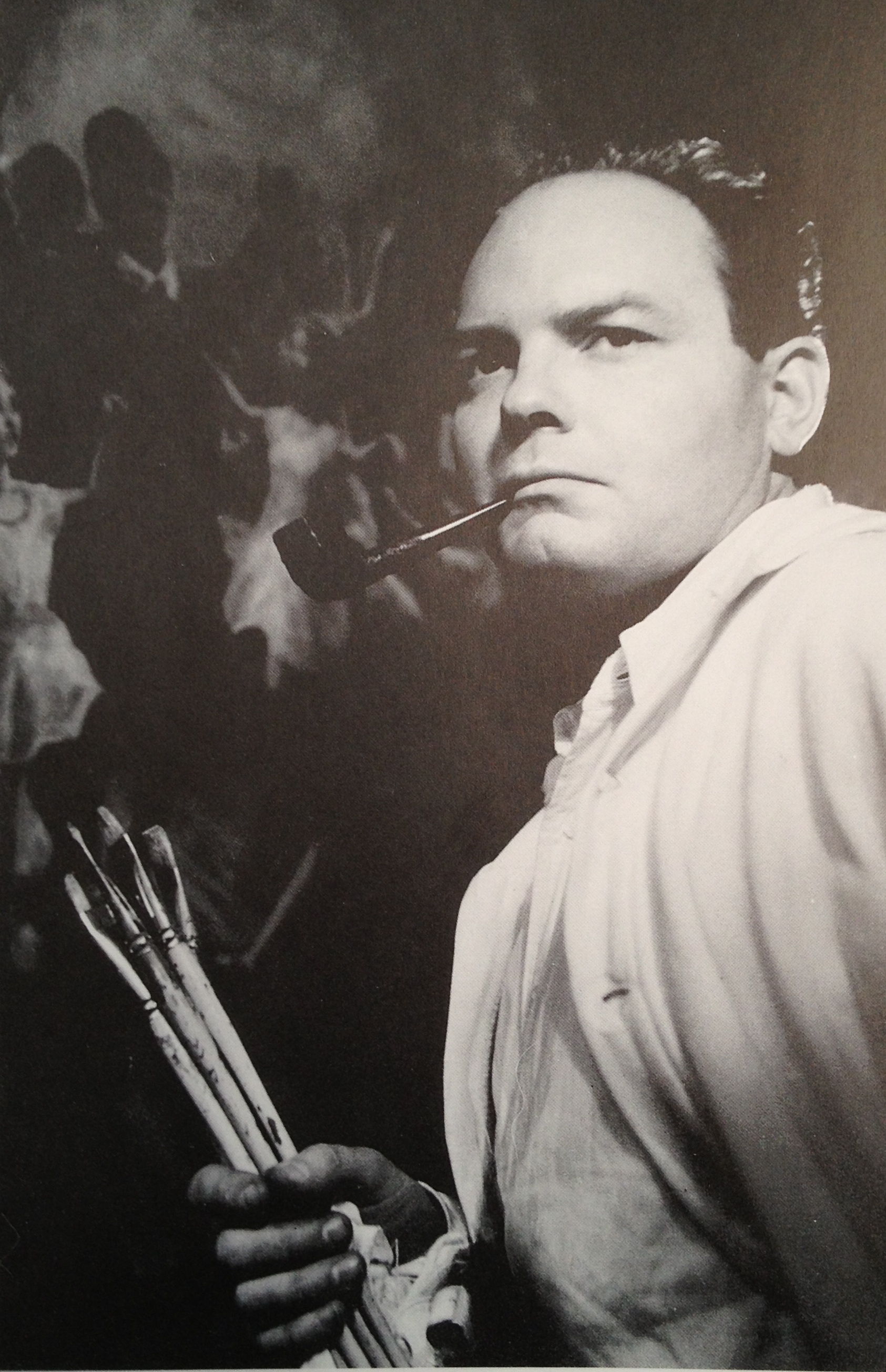
I believe the immediate source of the arm and grasping hand is the posture of Curry’s own upper body whenever he, like the farmer, stood before the products of his own labor. It is the pose Curry habitually struck when painting a self-portrait, an act he engaged in periodically during his adult life (fig. 9). [11] It’s a stance the camera caught as well (fig. 10. 11).
.
FIGURE 9
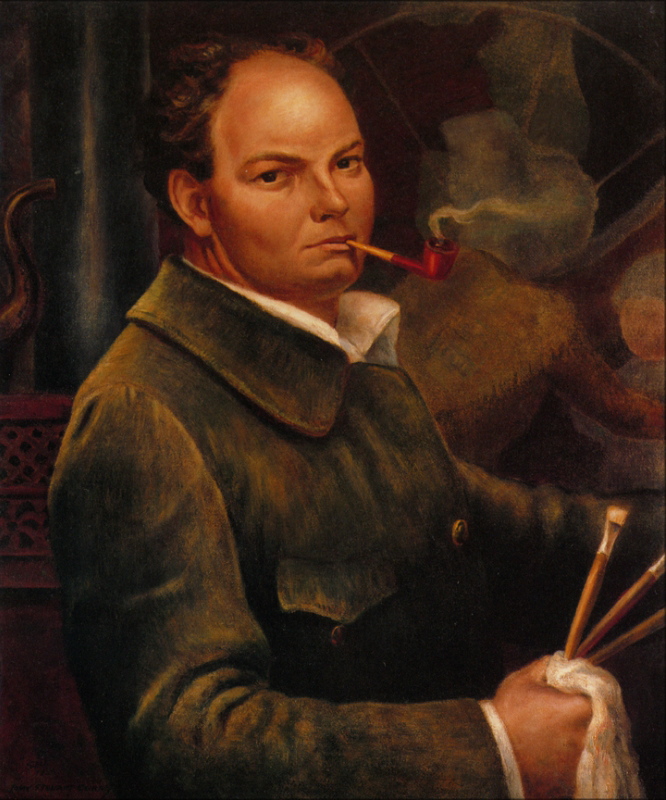 Self-Portrait, 1935, oil and tempera on canvas mounted on board, 30 1/4 x 25 1/8 in., signed, dated and inscribed lower left: SELF/1935/JOHN STEUART CURRY, Chrystal Bridges Museum, Bentonville, Arkansas
.
FIGURE 10
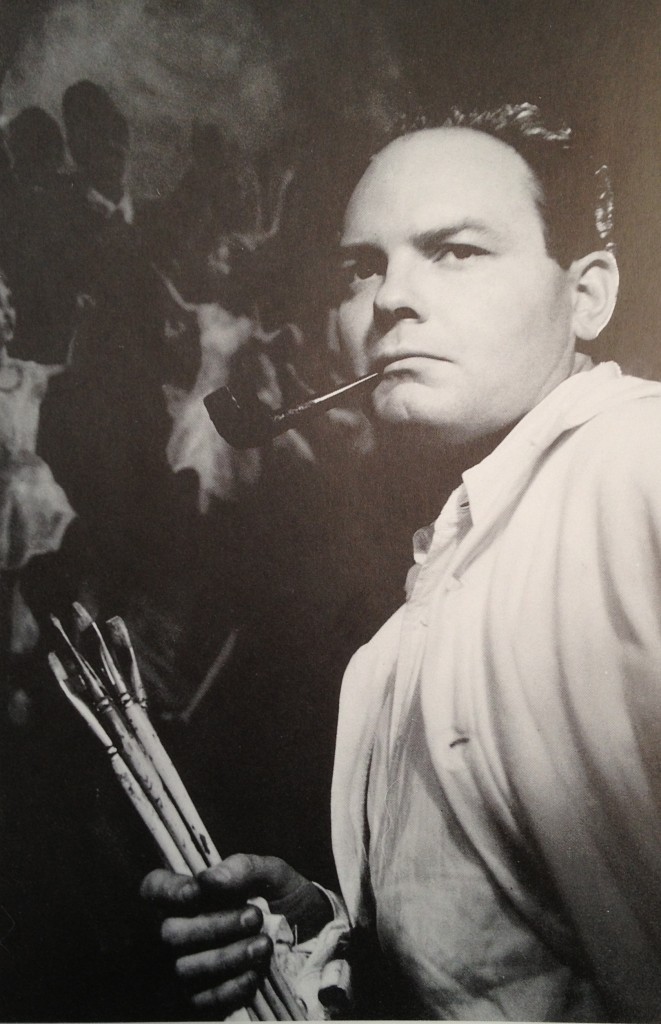 Curry in his studio c. 1929
.
FIGURE 11
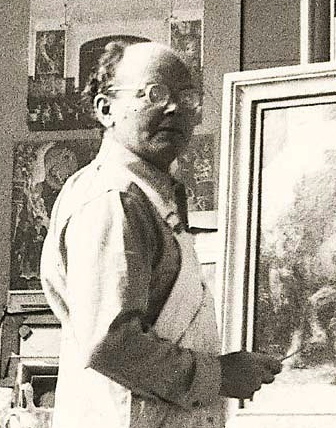 Curry at his easel, May, 1941
.
Scholars have documented the painstaking care with which Curry planned, developed, and adjusted his compositions for his major paintings and murals. [12] In the case of Our Good Earth, a photograph (fig. 12) shows the work at an advanced stage. Jack Delano, a photographer for the Farm Security Administration/Office of War Information photography projects, captured Curry in his Madison, Wisconsin studio, April, 1942. The artist stands before what is likely the large cartoon drawing {fig. 8} now in the collection of the Beach Museum of Art. A live model is present. One can assume the model’s purpose was not to serve as a “source” or “inspiration” for the picture, of course, since by this point Curry has already worked out the fundamentals of the painting and presumably all of the strategies by which its meaning would be conveyed. The photo is not evidence to prove or disprove the arguments made by Gambone, North or myself. And yet, it’s hard to resist remarking that the snapshot, in its homespun way, demonstrates how very little, if anything, Curry’s picture would owe to Adam or David upon its completion. [13]
.
FIGURE 12
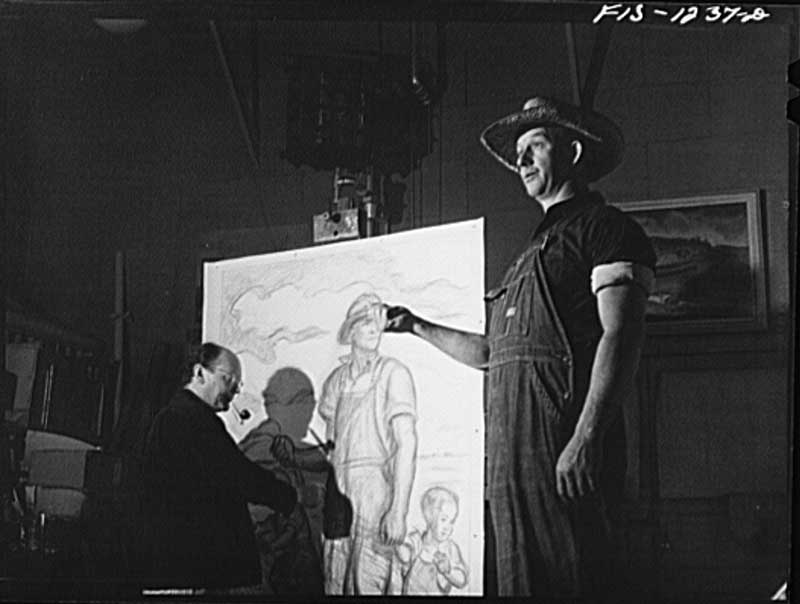
Mr. Malcom I. Ross, farm foreman at the Department of Agriculture at the University of Wisconsin, modeling for John Steuart Curry, April 1942, Madison, Wisconsin (photographed by Jack Delano for the Farm Security Administration/Office of War Information
.
IV. Searching for the Source
To conclude that Our Good Earth does not in any meaningful sense owe a debt to Dürer’s Adam or Michelangelo’s David is not to foreclose the possibility that its composition bears the marks or channels the spirit of one or more other landmarks in art history. In fact, I suspect that it does. While further research could well strengthen the ties (or undo them completely), let me propose the following.
A path that may prove fruitful is to consider the origins of social realism in American art of the Depression era, in both its urban and rural manifestations. Some historians trace the movement, which was embraced by many painters and graphic artists of that era, including the group of Regionalists to which Curry belonged, back in time to the development of realism in the art of the 19th century. A promising area to examine, then, is the territory occupied by European realism. One important strain of European realism is to be found in the work of the French artists of the Barbizon school, Gustav Courbet, Theodore Rousseau, and Jean-François Millet (1814-1875).
The notion that Millet in particular may have influenced Curry, and that his influence manifested itself in fully-resolved compositions on the part of the American, gains support from the visual evidence.
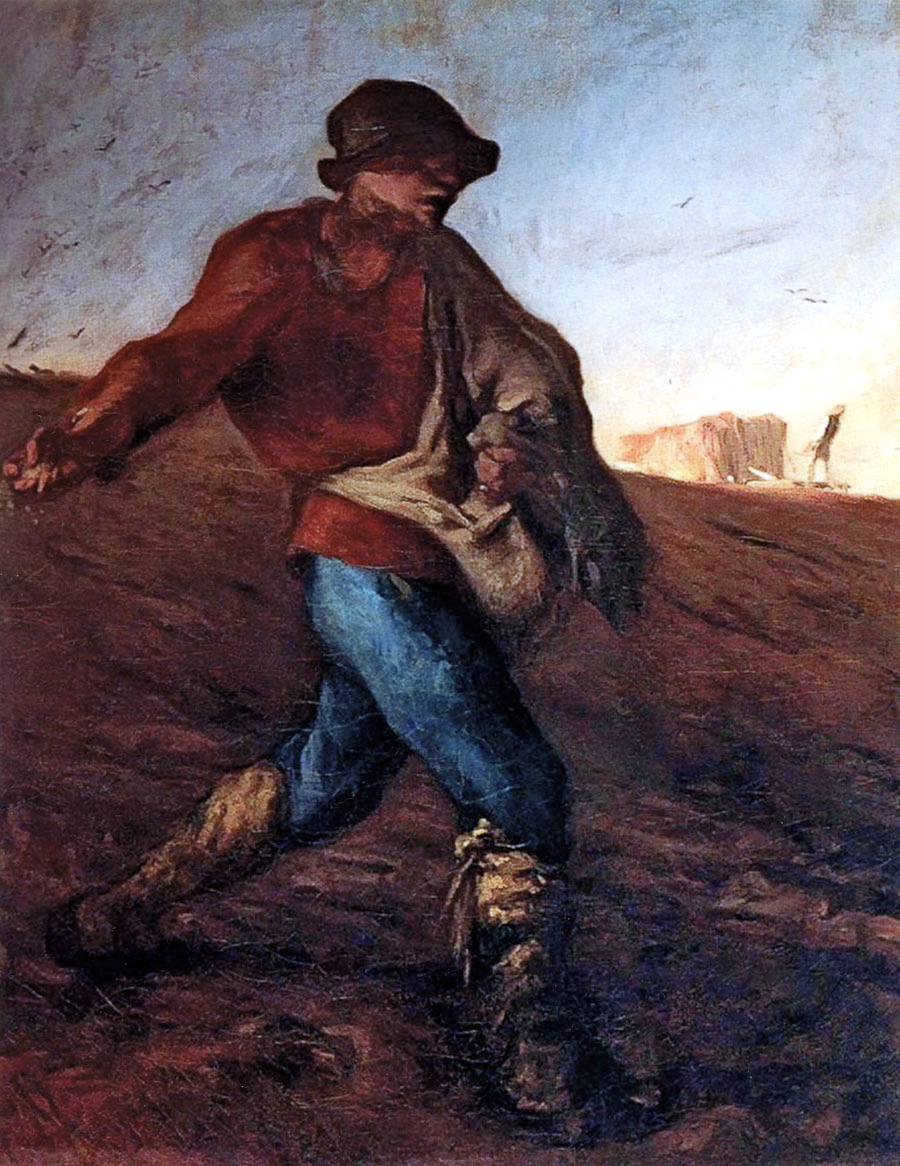
Consider, for example, one of Millet’s canonical depictions of agricultural workers, The Sower (Un Semeur) (fig. 13). Painted in 1850, it is generally considered the artist’s first masterpiece.
.
FIGURE 13
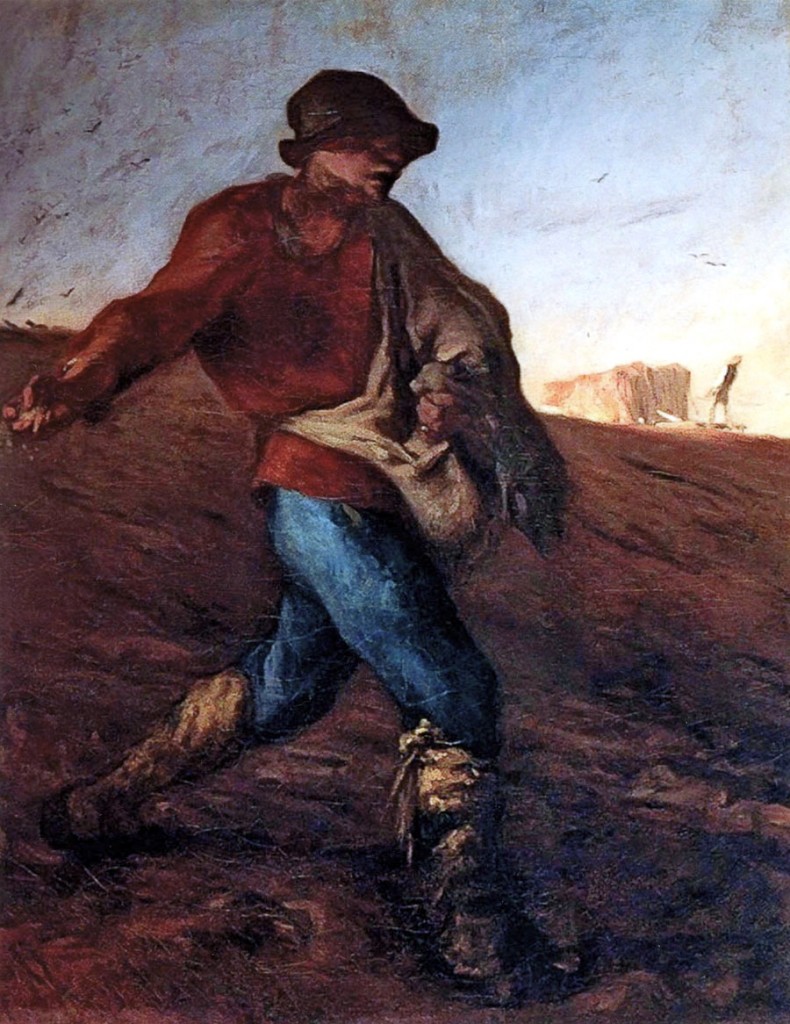 Jean-François Millet, The Sower (1850), oil on canvas, 40 x 32 1/2 in., Museum of Fine Arts, Boston, MA
.
As is the case with Our Good Earth, the image of The Sower exists in multiple iterations. Millet himself executed a few copies of the work in oil on canvas, after completing the apparent “original,” which made its way to America as early as 1851-1852. [14] There are also a few preliminary drawings that have survived (fig. 14), along with a lithograph (fig. 15) and a gouache (fig. 16). Engravings and photo-mechanical reproductions of The Sower were made for purchase by the public. Reproductions of Millet’s masterpieces attracted the eyes of American tourists in France in the second half of the 19th century who returned home bearing these tokens of high culture (fig. 17).
.
FIGURE 14
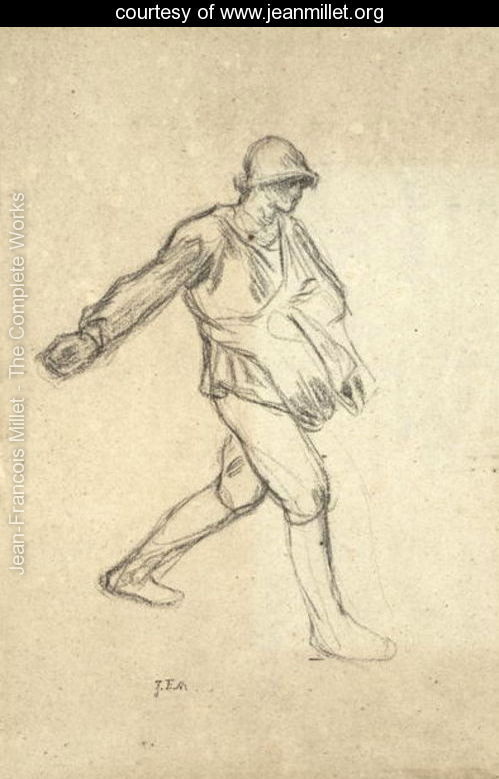
Millet, The Sower, preliminary drawing
.
FIGURE 15
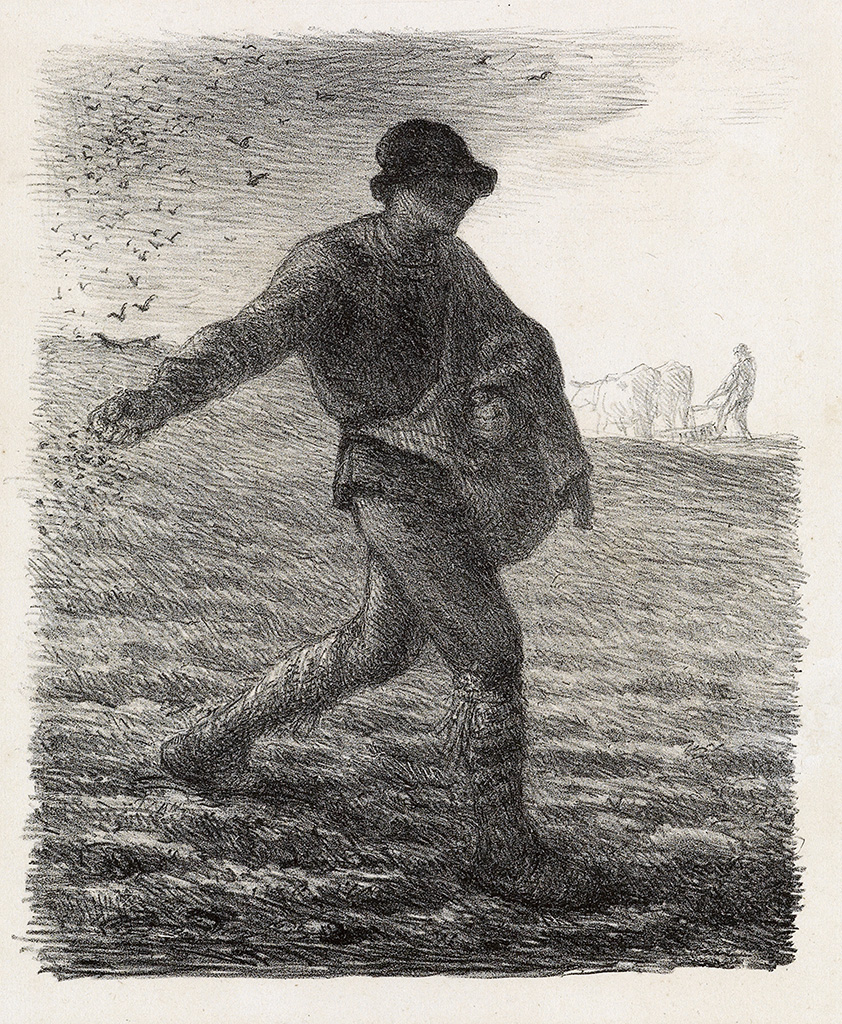
Millet, The Sower, lithograph
.
FIGURE 16
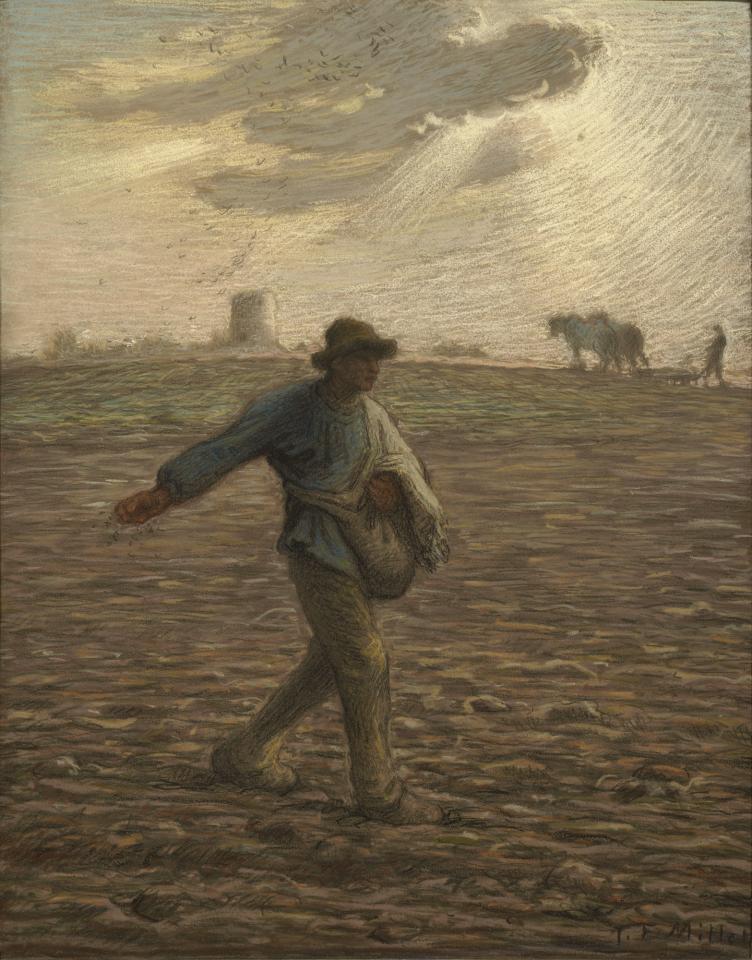
Millet, The Sower, 1865
.
FIGURE 17
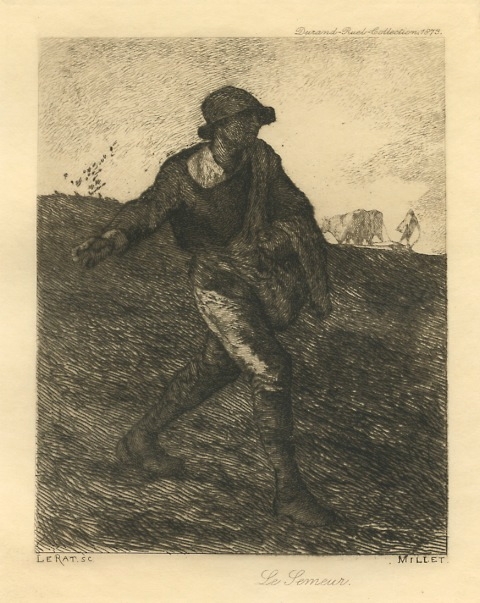
Millet, The Sower, engraving, 1873
.
The Sower achieved immediate renown, not only among Millet’s fellow artists in France but also in the consciousness of a public with a growing interest in the fine arts. In short order the picture became one of the most widely-disseminated images in popular culture. Facilitating this was the availability of inexpensive reproductions that supplied newer generations of artists with an easy way to study and appropriate the image, or elements of it, for new purposes. [14A]
V. The Contagious Spread of The Sower
It was the American artist William Morris Hunt who, while studying in France in the early 1850s, not only became a pupil of Millet but also purchased the just-completed oil on canvas, The Sower (for the equivalent of about sixty dollars). A few years later, when he returned to the United States, Hunt brought the work with him and over the next few decades his example encouraged American collectors to acquire additional works by Millet. [15A]
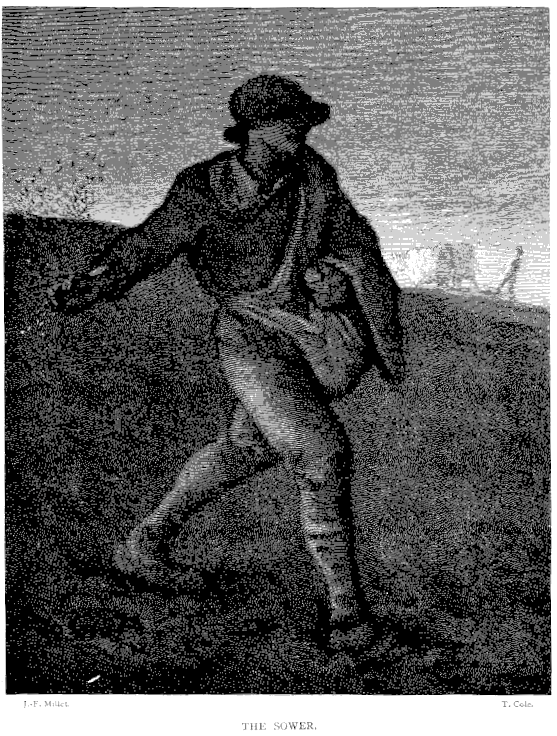
Winslow Homer (1836-1910), early in his career, studied the paintings Barbizon artists from reproductions. A close friend of Homer’s, the American artist John La Farge, later recalled how, in the 1850s, “not being able to see the originals, he [Homer] drew from the French lithographs we had here, which were almost entirely devoted to the reproduction of [paintings by Millet, Corot and Rousseau].” [15B] Art historian Henry Adams relates how Homer “borrowed heavily from Millet’s Sower for an illustration of the life of the American farmer in Scribner’s Monthly magazine.” [16] Millet’s title was appropriated and applied to his drawing (fig. 18). Three years later, the general audience of American readers could study a reproduction of Millet’s painting (fig. 18A) when it appeared as the frontispiece to an issue of Scribner’s Monthly that included a lengthy article about Millet’s life and work. [16A]
.
FIGURE 18
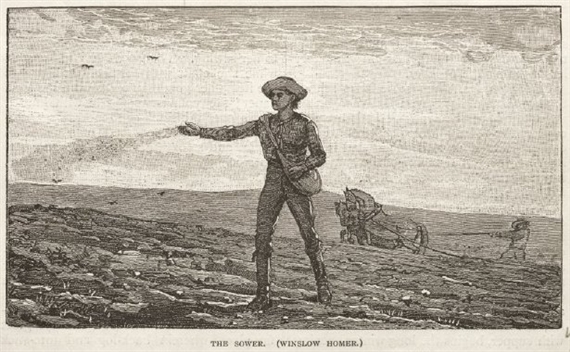 Winslow Homer (1836-1910), The Sower, 1878, wood engraving on wove paper, 4 3/8″ x 6 5/8″
.
FIGURE 18A
.
In France, among the younger generation of artists, Vincent Van Gogh (1853-1890) was unmatched in his reverence for Millet. [17] Of the many works — 21 by one count — that Van Gogh created in response to The Sower, some were copies after the work while others are acts of selective appropriation, as when Van Gogh lifted the lone peasant and resettled him in a different topography. When, after his death in 1890, Van Gogh became a hero to subsequent generations of artists, his practice of reusing the heritage of Millet inspired artists, including those in the U.S., to do likewise.
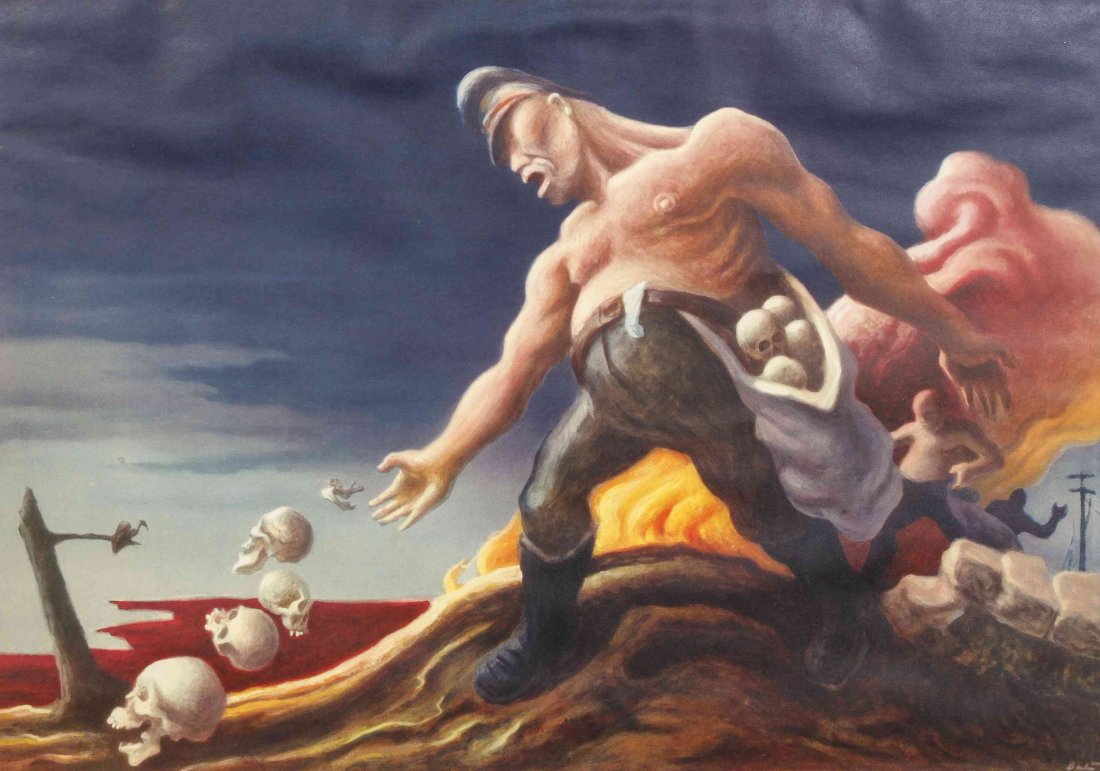
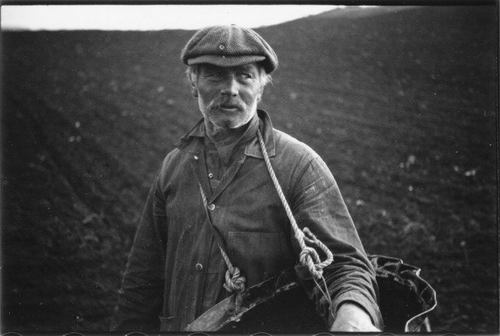
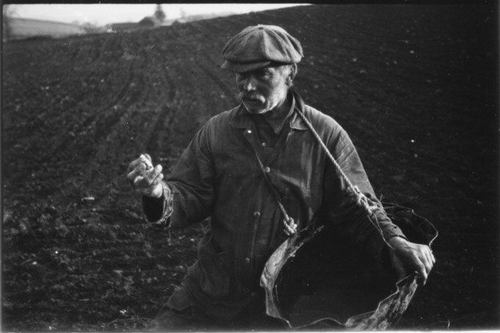
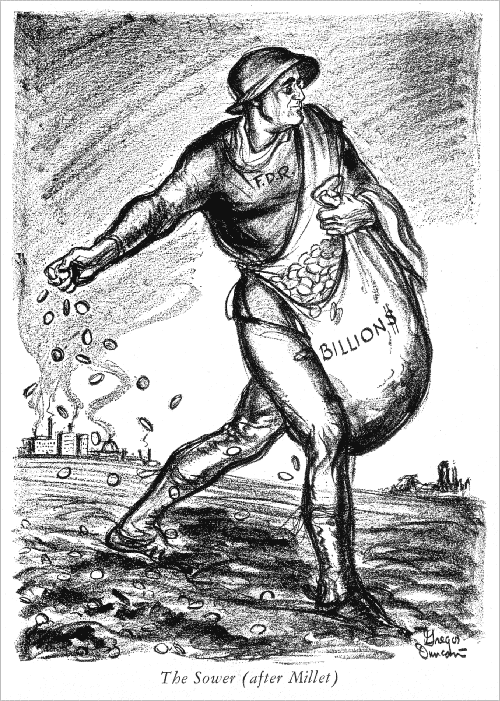
Among Curry’s generation of American painters who came of age in the 1920’s and 1930’s, the example of Millet was an essential element of their education. It is not an exaggeration to say The Sower in particular belonged to almost everyone’s visual literacy during that period. This meant the image’s renown and resonance could be tapped for a variety of public purposes. Image-makers who copied, borrowed from, or made winking allusions to The Sower were legion — from the photographer Walker Evans (fig. 19, 20), to the political cartoonist Gregor Duncan (fig. 21), to Curry’s fellow-Regionalist and fellow-propagandist on behalf of the nation’s WWII effort, Thomas Hart Benton (fig. 22). [18]
.
Figure 19
 Walker Evans, Sower, Copake (1933)
.
Figure 20
 Walker Evans, Sower, Copake (1933)
.
Figure 21
 Gregor Duncan, Life Magazine, April 1934
.
Figure 22
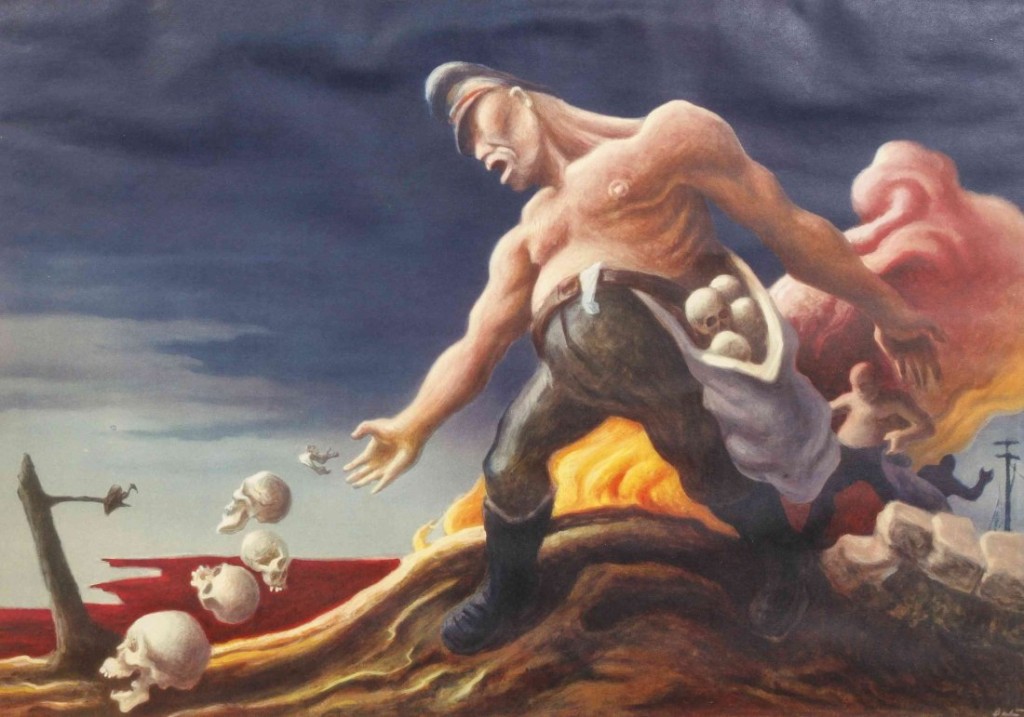 Thomas Hart Benton, The Sower (1942), tempera
.
VI. The Curry-Millet Connection
That Curry had an attachment to and productive relationship with The Sower is well documented.
His exposure to the picture may have begun at a very early age. During his upbringing in Kansas, we know his visual imagination was stimulated by daily exposure to one or more reproductions of Millet’s work — reproductions that his parents framed and placed on the walls of his childhood home. In an interview conducted in 1935 Curry remembered fondly the art prints his mother and father brought back from their European honeymoon sometime in the 1890s. He recalled:
“My mother was also a remarkable woman. She brought back from that trip good reproductions of the best art of Europe. Instead of grain and feed calendars in our house as the only art, we had Rubens, Bellini and Millet. That was unusual and had a great deal to do with forming my future.” [19]
While I’ve found no evidence that it was The Sower that each day greeted the young Curry in that home [20], it is certain that The Sower would have been part of Curry’s later education as an art student and his ongoing practice as an artist. For example, during his years on the east coast starting in 1920 (when he was just 23 years old), and then when he lived and worked in New England starting in 1924, he surely would have made at least one trip to Boston, where he would have seen The Sower at the Museum of Fine Arts, where the painting had been part of its permanent collection since 1917. A bit later, when he visited Paris in 1926, Curry might well have seen one of Millet’s other painted versions of the picture. [21]
When Curry was commissioned in 1937 to begin work on a set of murals for the Kansas State Capitol, he surely knew and appreciated the fact that he was following the in footsteps of George Melville Stone (1858-1931), a native Kansas artist of the previous generation whose 1920 painting, The Pioneers, was hanging in the statehouse. Stone was popularly known by the moniker, “The Millet of the Prairies.” [22]
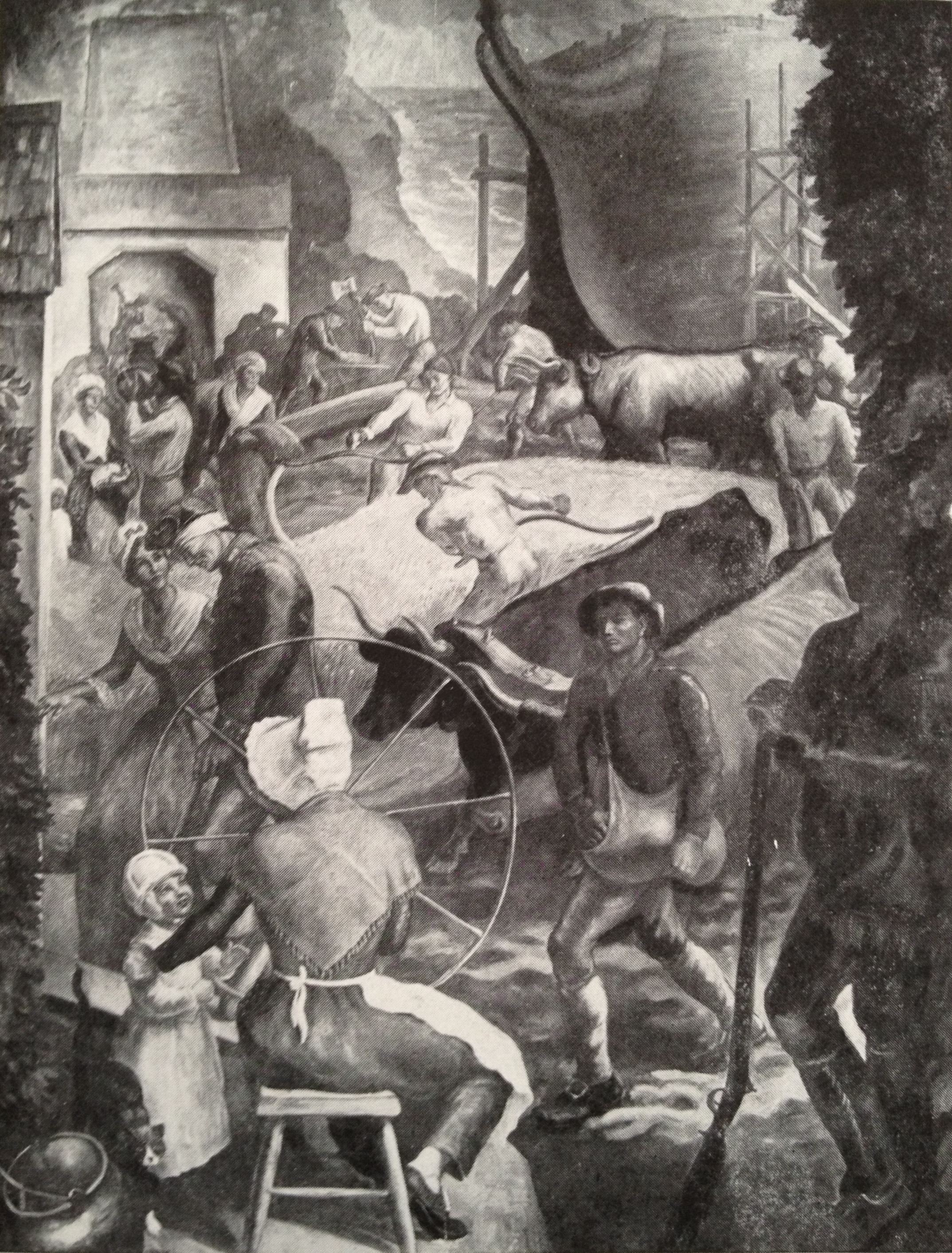
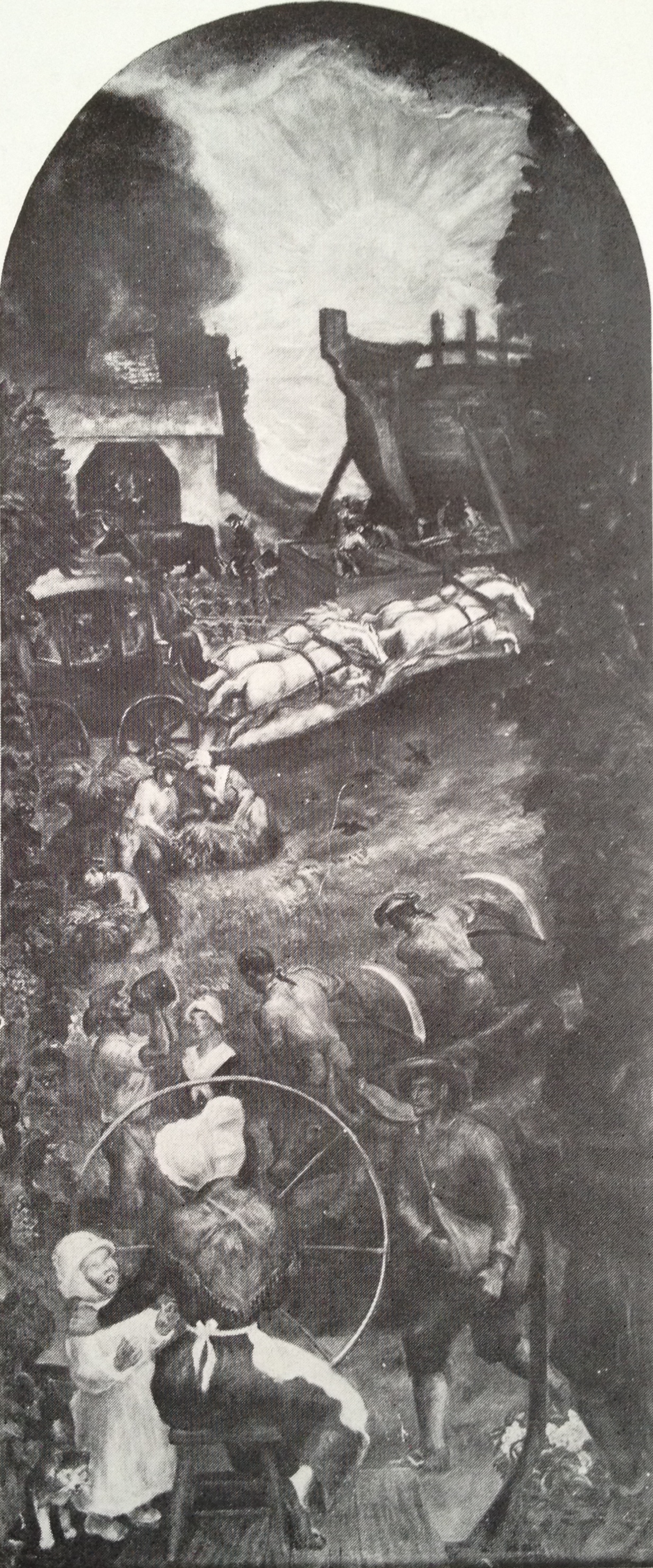
Indeed, by the 1930’s Curry had already begun to bring Millet to America. In that decade he incorporated the figure of the sower into two mural commissions. [23] The first, Labor of the Common People (oil on canvas, 10′ x 14′, 1931, destroyed) was produced for the Centennial Exhibition held in Washington, DC, in 1932 (fig. 23). Its busy composition includes in the lower right quadrant a figure patterned on the farmer in The Sower. Five years later Curry incorporated a nearly identical figure into the lower portion of the vertical composition of Ancient Industry, one of two murals Curry completed for Norwalk High School in 1936 under the sponsorship of the Public Works of Art Project (fig. 24).
.
FIGURE 23
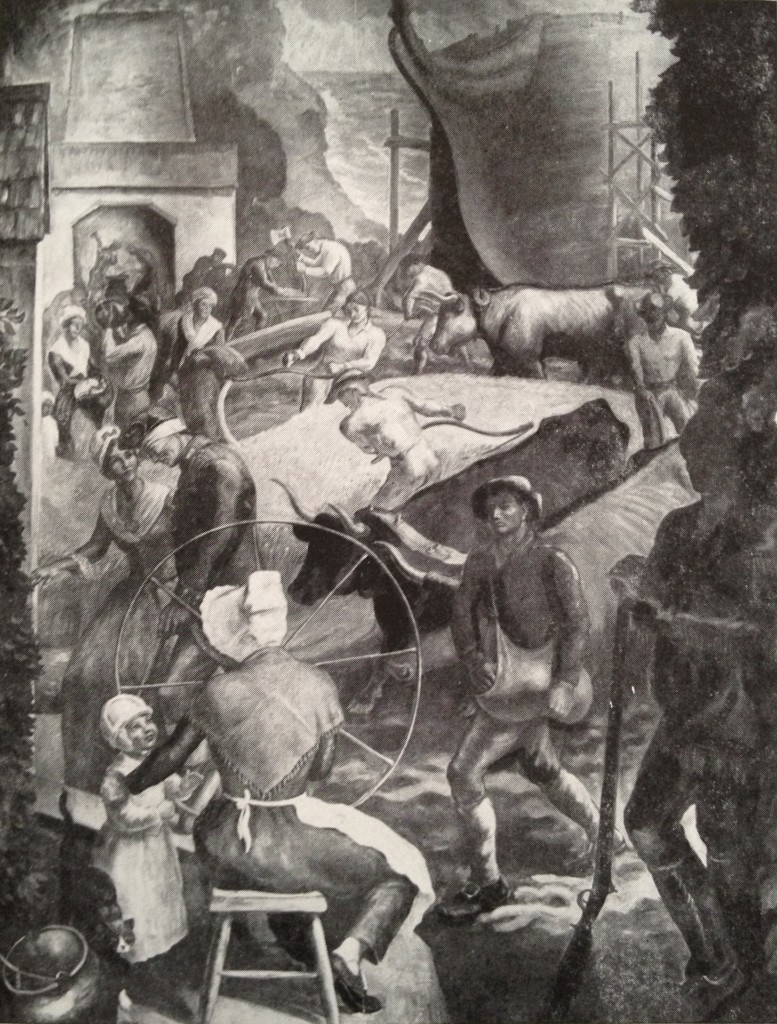 Curry, Labor of the Common People, 1931 (destroyed)
.
FIGURE 24
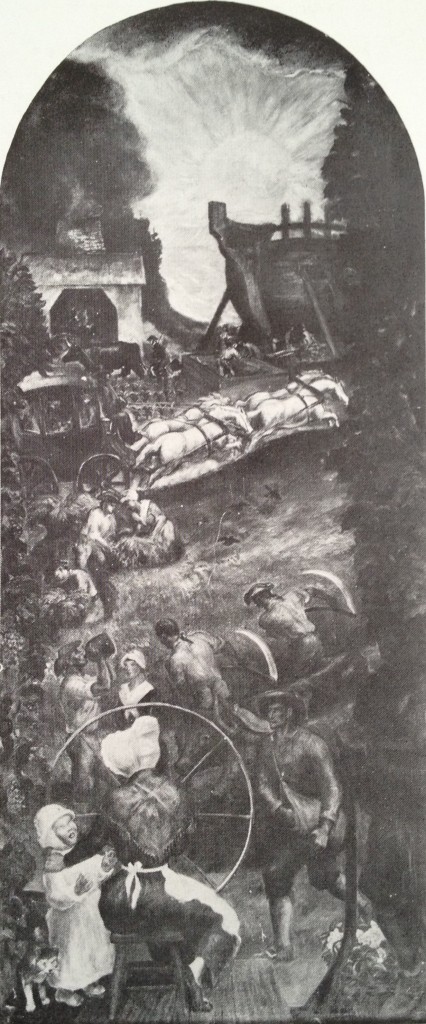 Curry, Ancient History, 1936, Norwalk High School (mural)
.
Around the time he completed Our Good Earth, Curry appears to have been mindful of Millet’s peasants when choosing a template for his illustration of Walt Whitman (fig. 25), that quintessential American poet and early admirer of the prairie, for new edition of Leaves of Grass. [24] Whitman himself had seen The Sower in 1881 during a visit to the Bostonian, Quincy Shaw, in whose private collection the painting then resided. Whitman later remarked that his Leaves of Grass was “really only Millet in another form” and that in the painters work one can find “the best of democracy.”[24A]
.
FIGURE 25
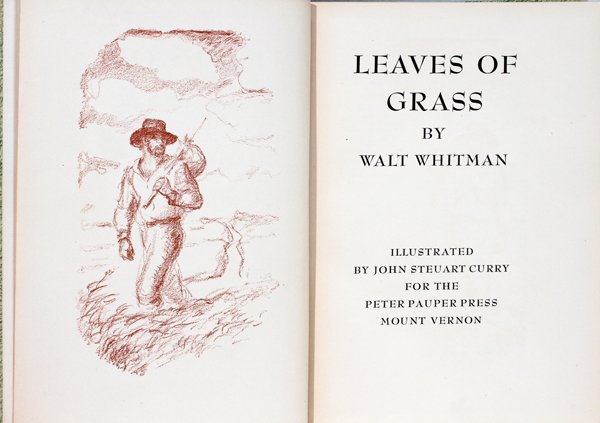
Walt Whitman, Leaves of Grass, 1943, illustrated by John Steuart Curry
.
The striding figure of a peasant foregrounded in Millet’s Le Départ pour le Travail (fig. 26), carrying a pitchfork over his shoulder, may also have provided the specific cue for a pitchfork toting farmer centrally positioned in Curry’s 1942 mural Wisconsin Agriculture Leads to Victory (current location unknown). [25] Curry replicated the image in an oil on canvas, The Farm is a Battlefield, Too (fig 27) that became the basis for another wartime propaganda poster following the artist’s success with Our Good Earth. [26]
.
FIGURE 26
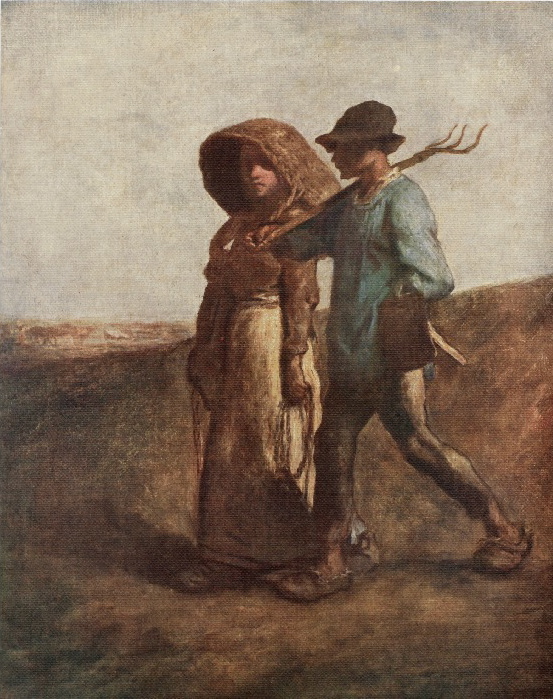
Millet, Le Départ pour le Travail
.
FIGURE 27
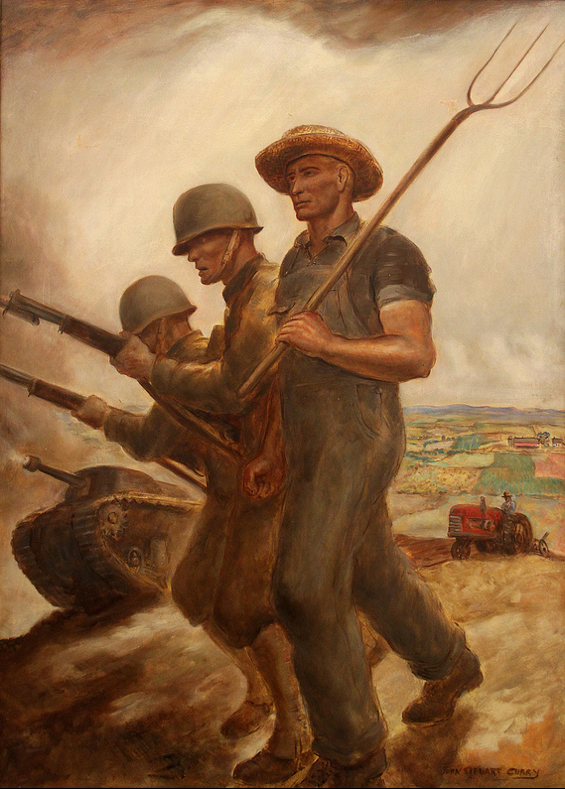
Curry, The Farm is a Battlefield, Too, oil on canvas, ca. 1942-43, Figge Art Museum, Davenport, Iowa
.
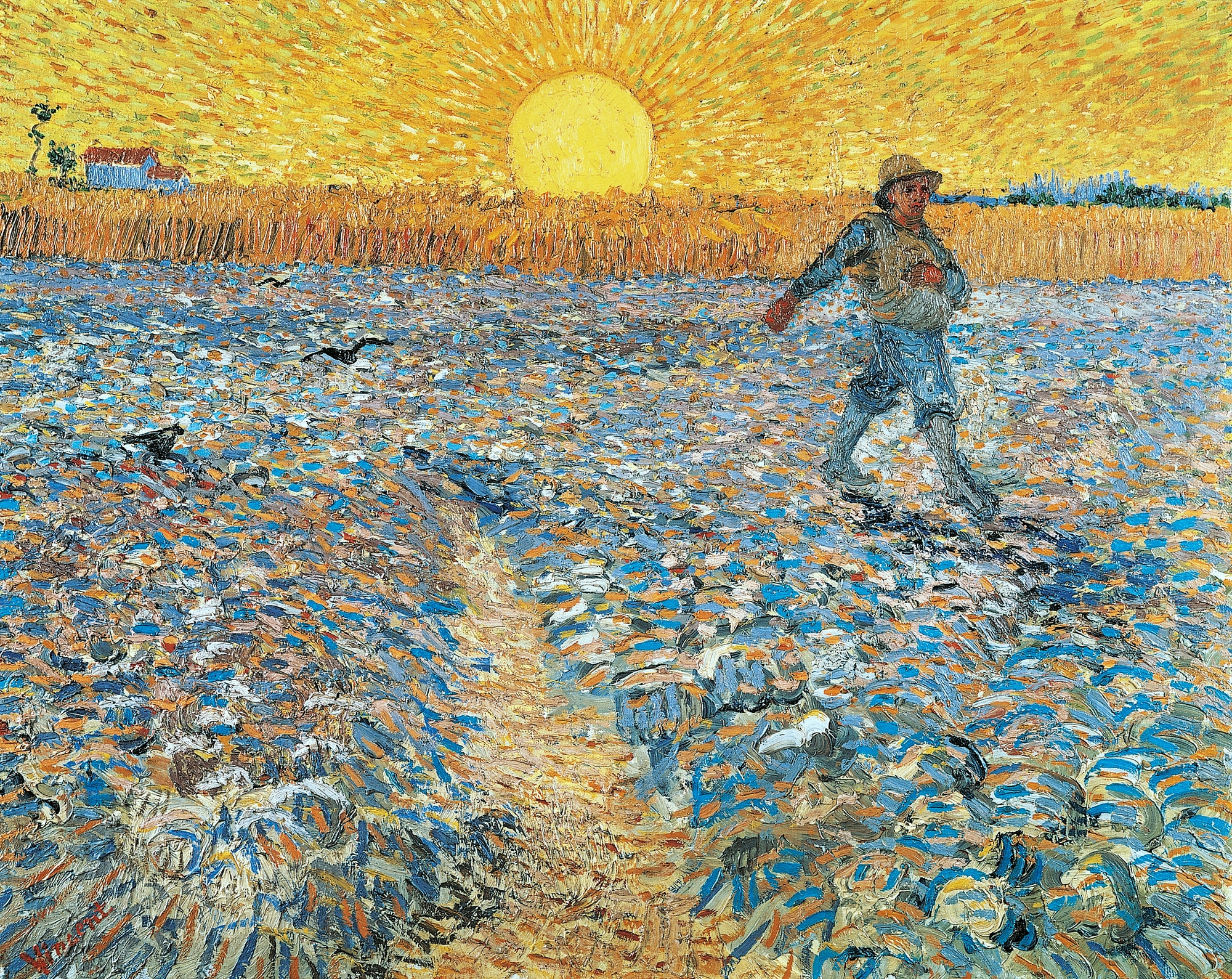
Whether Curry was aware of Van Gogh’s frequent re-use of Millet’s image of a farmer in a field has not been established, though it is a distinct possibility. [27]. One of Van Gogh’s homages, titled After Millet’s The Sower (fig. 28), is especially significant to the present discussion. In it Van Gogh smooths Millet’s hilly fields into a Kansas-like flatness, and then inserts a blazing sun that mimics a sunflower. [28] There’s an intriguing parallelism with Our Good Earth in the significance of the relationship of the figure to the horizon line. This is best seen by juxtaposing Van Gogh’s painting with a preliminary drawing for Our Good Earth now in the collection of the Smithsonian Museum of American Art (fig. 29). In both compositions the placement of tiny structures on the horizon emphasizes the vastness of the fields. What is different is that Van Gogh threads the horizon line through the head of the farmer (fig. 30) while Curry superimposes on the horizon his farmer’s muscled right forearm his seed-bearing right hand (fig. 31). As a general matter the horizon line in landscape painting is rich which metaphorical meaning. To what ends Van Gogh and Curry exploited this richness I leave to the reader’s interpretation.
.
Figure 28
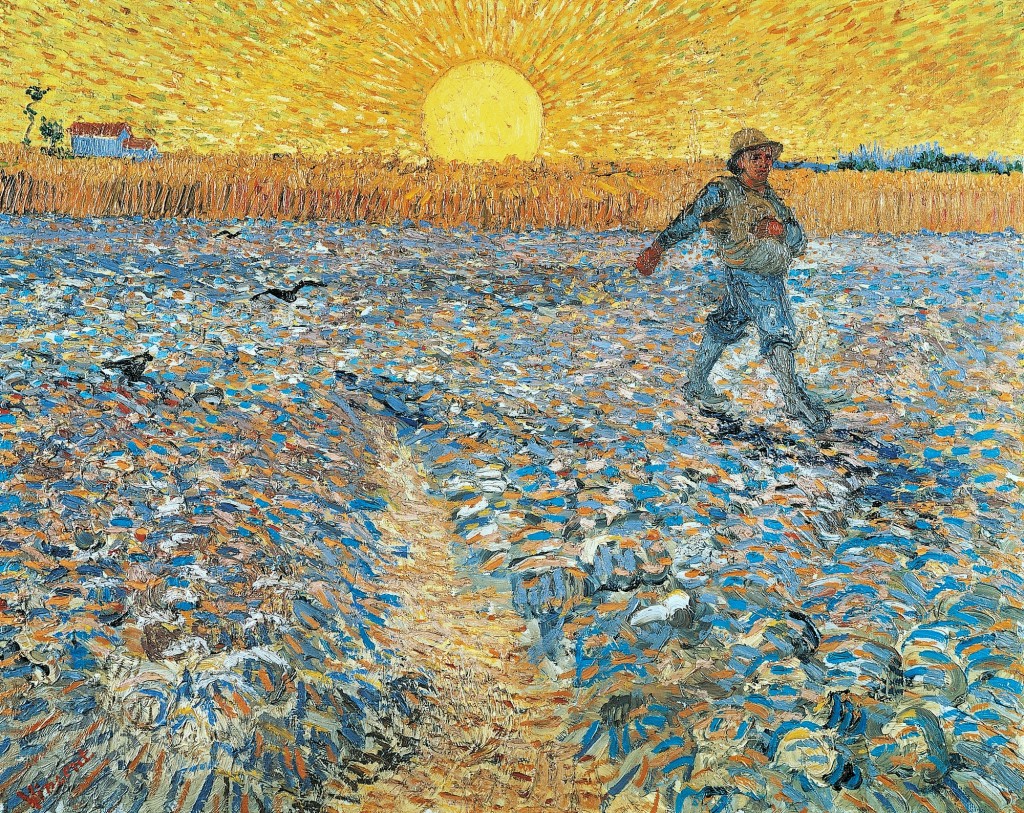 Vincent Van Gogh, The Sower, 1888
.
Figure 29
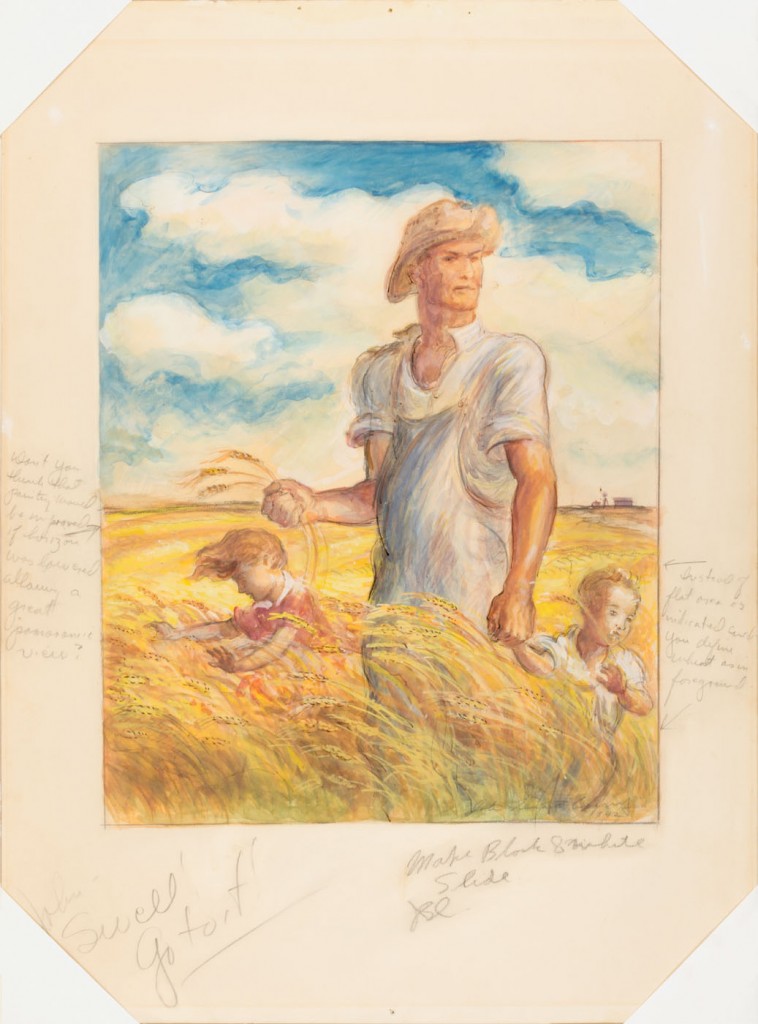 John Steuart Curry, preliminary drawing for Our Good Earth
.
Figure 30
 Van Gogh, The Sower, 1888 (detail)
.
Figure 31
 John Steuart Curry, preliminary drawing for Our Good Earth (detail)
.
VII. Curry’s Americanization of Millet
And so my proposition is this: Our Good Earth is Curry’s re-interpretation of Millet for an American audience. In the painting we see Curry engaging in a dialog with an admired predecessor. Our Good Earth is not an imitation of Millet so much as it is an optimistic refashioning of Millet’s sympathies and values, in a new nation’s garb. Curry Americanizes Millet.
Many French writers who were contemporaries of Millet recognized the epic power of The Sower. One of them was Théophile Gautier (1811-1872). He was not only a poet, dramatist and novelist, but also a leading art critic of the period. He described the painting in this manner:
“The night is about to fall and to spread abroad its gray veils over the brown land. The sower marches in rhythmic step, casting the grain into the furrow; gloomy rags are his covering; his head is coifed by a sort of bizarre bonnet; he is bony and meager underneath this livery of poverty, and yet life springs from his broad hand, and with a proud gesture he, who has nothing, is spreading over the earth the bread of the future. At the other side of the hill, a last ray of light […]. This glimmer is the only clair of the picture bathed in a sorrowful shadow […]” [29]
To American ears, Gautier’s attempt to capture in words the affect and effect of the painting is sodden with romantic pessimism. A clear-eyed American artist, especially one newly commissioned to rally his fellow Americans in a time of emergency, would have little use for such sentiments. The fundamental song of Millet — behold a man spreading over the earth the bread of the future — would be re-sung by Curry, and he would re-use the essence of Millet’s image of an agrarian worker. But many other elements would have to be modified. First and foremost the farmer must be enveloped by a vision of the American Midwest.
Consider, for example, the time of day Millet depicts. It is dusk, and a far-gone dusk at that. A last ray of light struggles feebly to aid our perception. There is a chill in the air as seeds are dropped into their cold bed. Such an atmosphere would not do for a clarion statement of America’s strength and willingness to help defeat tyranny. So Curry set the scene in the heart of the day, a glorious warm day of high clouds aloft and robust wind below. The hill behind Millet’s sower, daunting and confining, is leveled to create a far horizon (the same adjustment Van Gogh had made).
Curry needed to decide on the relationship of his farmer to the earth. Then he needed to select the means to convey this meaning. Gautier had been especially struck by the “black soil” from which Millet’s sower naturally arises. Estelle M. Hurll, an American critic writing about Millet in the year 1900, observed how in all of Millet’s canonical works, “landscape and figure are interdependent, fitting together in a perfect unity.” [30] Two decades later the American writer Edna Ferber questioned the consequences of this sentimental marriage of soil and men in her novel, So Big (1924). [31] Ferber describes how farmers in her fictional midwestern community of High Prairie would labor in their fields until they “take on the very look of the rocks and earth among which they toiled.” Curry’s challenge was to split the difference between sentimentality and its opposite. While essentially accepting Millet’s concept of harmony between man and environment, Curry chose to demonstrate it differently. Tempting cliché, his American figure grows out of amber waves of grain. [32] Significantly, he reverses the motion-versus-stasis bias in Millet (the sower strides with determination across the still earth) to present a man determinedly anchored upon a wind-whipped terrain. Man emerges from the earth, yes, but with this crucial difference: this American farmer has achieved a command of nature, as proven by the abundance that surrounds him. [33]
Note as well how the French peasant’s tattered “livery of poverty” is exchanged for the clothing of an American midwesterner, crisp and clean. The “bizarre bonnet” worn by the sower is alluded to in the farmer’s well-worn straw hat. I interpret this detail not as a woeful sign but as a humanizing touch, a comical eccentricity. I imagine the farmer’s unseen wife regularly threatening to toss that silly old hat to the pigs.
Yet another example of Americanization is the decision Curry makes to flank the farmer with his young son and daughter. This dismisses the atmosphere of lone and lonely heroism of the The Sower‘s protagonist and replaces it with a different mood. We see a man showing off his accomplishment in the company of his family, significantly the next generation of his family, in a composition whose very title — OUR Good Earth — reminds the viewer of the communitarian character of American success that benefits succeeding generations.
The sower grasps in hand and from it disburses seeds, while pacing through the still-barren field. In contrast the farmer stands in a field ripe with harvest, clutching celebratory sprigs of seeds. They are also symbols that the cycle will continue.
All of which is to say Curry’s picture finds Millet’s peasant farmer re-planted in American ground — a soil that in our foundational American myth breeds a new class of free yeoman farmers.
VIII. Seedtime and Harvest
Robert Gambone rightly stresses the use of religious motifs in Curry’s art. However, as mentioned above, Gambone’s analysis of Our Good Earth extends only as far as to assign a modest religious aura to the work, emanating from a connection between Our Good Earth and Dürer’s figure of Adam (a connection I find questionable). While I believe there is indeed a profound connection between Our Good Earth and the Bible, it is a relationship in which Millet, not Dürer and not Michelangelo, plays the essential role.
What is this religious tie?
The Sower and Our Good Earth are bookends, the two images holding up to our contemplation an age-old parable. The source is a familiar Biblical admonition — an exhortation that is at once a warning and a promise. It is found in in the New Testament books of Galatians 6:7 (“Whatsoever a man soweth, that shall he also reap”) and 2 Corinthians 9:6 (“He which soweth sparing shall reap also sparingly; and he that soweth liberally shall reap also liberally”).
Curry’s picture responds to The Sower by answering Millet’s opening prayer with a closing benediction. It forms a call-and-response that Curry completes. The parable is made whole.
But beyond this there is another aspect of Our Good Earth worth consideration.
Millet’s peasant paintings all depict daily agrarian activities with great sensitivity, yet the artist was primarily attracted to just part of the full cycle of God’s earth, typically the initiation (going to work, commencing the process). The cycle in its fullness is announced most powerfully in Genesis 8:22 — “seed time and harvest, and cold and heat, and summer and winter, and day and night shall not cease, so long as the earth remaineth.”
The Sower pays homage to the seed time; the atmosphere it captures is cold, as winter is (still) in the air; night draws near. Curry’s Our Good Earth shifts our reflection to antipodal stations in the cycle. It celebrates the harvest, in the remaining warmth of the year, at the height of day. In this way too the painting is a very American answer to Millet.
IX. A Successful Commission
Imagine the two images, The Sower and Our Good Earth, hanging side by side in a room, somewhere in America. It is the war year 1942. Conjure up in your mind the flesh and blood farmers represented on the wall by their iconic stand-ins. Consider how these men, separated by time and space, are drawn together into a compact, a reciprocity ordered by the cycle of sowing and reaping. It becomes possible for you to believe that somehow the seeds planted by one farmer in a prior century on European soil are today fulfilling their promise in another farmer’s bountiful harvest in America. The year is 1942: Do you hear, America, a call from Europe, a present call of duty?
_______________________
NOTES
1. The exhibition, John Steuart Curry: Inventing the Middle West, was organized by Patricia Junker in association with the Elvehjem Museum of Art. Opening at the Elvehjem Museum (March 7-May 17, 1998), the show traveled to the Fine Arts Museums of San Francisco (June 13-August 30, 1998) and the Nelson-Atkins Museum of Art, Kansas City, Missouri (October 11, 1998-January 3, 1999). It was accompanied by a catalog: John Steuart Curry: Inventing the Middle West, Patricia Junker with contributions by Henry Adams, Charles C. Eldredge, Robert L. Gambone, M. Sue Kendall, Lucy J. Mathiak, and Theodore F. Wolff, Hudson Hills Press, New York (1998).
2. Junker, John Steuart Curry: Inventing the Middle West, “Annotated Chronology,” p. 236. See also the brief segment devoted to the creation of “Our Good Earth” as a war poster, here: http://www.biblicalwritings.com/encyclopedia-of-bible-and-theology/?word=Artwork_by_John_Steuart_Curry. The painting and poster, along with Curry’s other World War II era works, are examined, with copious references, here: http://en.wikipedia.org/wiki/Artwork_by_John_Steuart_Curry.
3. The Spririt of the Thirties: Selections from the Collection of the University of Maryland Art Gallery, 1982, unsigned essay related to the lithographic version of Our Good Earth, p. 20.
4. Primary information about the oil painting can be found at the Chazen Museum’s website, here. Examples of the poster in its larger format (approx. 60 x 40 in.) can be found at http://www.wikipaintings.org/en/john-steuart-curry/our-good-earth-keep-it-ours-1942; see also here , here (with folds), and here. A high-resolution image (though color-challenged) is available on the National Archives site, here. An example of the smaller format (22 x 14 in.) appears here. In a letter dated October 5, 1942 from Reeves Lewenthal, Direct of Associated American Artists to Curry, Leventhal refers to “the three sizes of your war poster” (though I have only found two sizes). A booklet issued in 1942 to persuade American farmers to buy War Bonds, which re-uses Our Good Earth as the cover image, is described at http://ephemerastudies.org/gallery/war-bonds-for-farmers-1942-john-steuart-curry/. The stone lithograph is Cat. 36 in The Lithographs of John Steuart Curry: A Catalogue Raisonne, compiled and edited by Sylvan Cole, Jr., Associated American Artists, New York (1976). In the Introduction to that Catalogue Raisonne, Laurence Scheckebier observes how “for the most part the prints were not stages or experiments in the evolution of a given problem but they are rather the perfected solution.” This, in my view, is true in the case of Our Good Earth. [See Note 6, below, for information on the unresolved confusion over the date of the lithograph.]
5. See Note 1; Gambone’s essay appears on pp. 133-149 of the catalog. A brief, enlightening essay on Dürer’s engraving of Adam and Eve can be found at: http://www.metmuseum.org/toah/works-of-art/19.73.1; its author suggests that Dürer may have based his Adam on the Hellenistic Apollo Belvedere.
6. Gambone, pp. 145-146. The date 1938 Gambone assigns to Curry’s lithographic version of the image is problematic. The compiler of the 1976 Catalogue Raisonne of Curry’s lithographs (and long-time Director of Associated American Artists) Sylvan Cole attached the year 1942 to the print. However, writing in 1981, Joseph S. Czestochowski provided additional information:
“A measure of uncertainty exists about the date of this lithograph. In a catalogue accompanying a September 5 – October 15, 1946 exhibition of Curry’s work at the Milwaukee Art Center, Our Good Earth was dated 1940-1941 (No. 170, lent by Associated American Artists, New York). Also, the impression in the Library of Congress collection is dated 1938. As such, it is quite possible that the composition was developed by Curry over a series of years, until the design was satisfactory.”
Joseph S. Czestochowski, John Steuart Curry and Grant Wood: A Portrait of Rural America, University of Missouri Press, Columbia & London, 1981, p. 124. Two variants of the lithograph (“Stone 1” and “Stone 2”) are in the collection of the Figge Art Museum in Davenport, Iowa (thumbnail illustrations here: http://www.figgeartmuseum.org/getdoc/afec690e-2d9b-4aad-bd5a-f7d1a880e7cc/c.aspx?page=8).
6A. As for the “massive upper body” Gambone suggests can be traced to Dürer’s Adam, collections of Curry’s drawings show he had more much immediate experience in seeing and drawing such figures, as can be seen here, here, here, here and here.
7. For insights into the father and son relationship, see Charles C. Eldridge’s essay, “Prairie Prodigal,” in John Steuart Curry: Inventing the Middle West, pp. 89-109. Eldridge observes that the parental pose Curry captured in 1929 (“the father stands with booted feet squarely planted … amid his flock”) is a pose the artist returned to again and again. Examples are his composition of Our Good Earth and depictions of John Brown. To that list of examples I would add the commanding central figure in the lithograph, The Plainsman, 1945 (Cole 40), which is based on a mural in the Kansas State Capitol in Topeka (http://www.imamuseum.org/collections/artwork/plainsman-curry-john-steuart).The print was published by Associated American Artists the year before Curry’s death in 1946.
8. A photograph of the Curry family in John Steuart Curry: Inventing the Middle West (p. 91) shows the artist as an adult standing a few inches shorter than his father.
9. See, e.g., http://www.artistbrushstrokes.com/artist_brush_basics.htm.
10. Bill North, The Regionalist Vision of William Dickerson: Selected Paintings from the DeVore Collection, The Beach Museum of Art, Kansas State University (1997), pp. 15-16
11. The erect arm, plying the tools of his trade, also conveys the working artist’s solidarity with workers in other fields. It was an often-used trope in the 1930s. The Thomas Hart Benton’s self-portrait that appeared on the cover of Time magazine (December 24, 1934) featured a similar at-work pose: http://blogs.kcai.edu/125/2010/06/03/thomas-hart-benton/ (the magazine’s cover story can be read here. Curry’s hand again clutched several brushes, paint-laden with primary colors red, yellow, and blue, in a 1937 Self-Portrait: http://www.wikipaintings.org/en/john-steuart-curry/self-portrait-1937. Contrary to Bill North’s conjecture, there is nothing symbolic or otherwise referential in the number of brushes Curry clutches. Self-portraits and photos exist that show him holding one, two, three, and four brushes; and in one of his self-caricature drawings he wields a single “brush” the size of a house broom. Finally, to state the obvious, Curry liked the gesture of a half raised arm ending in a fist because it was a ready way to signify “determination” — see, e.g., the drawing, Study for Westward Expansion, c. 1937.
12. See, for example, the many preliminary drawings and the explanation of step-by-step development of compositions traced by Laurence E. Schmeckebier in John Steuart Curry’s Pageant of America, American Artists Group, New York, 1943. Among the Curry correspondence recently digitized by the Smithsonian’s Archives of American Art is a letter from 1944 in which the artist joshes, “Will see what can be done about a brand new picture for the opening. I might whip out a masterpiece over night, but usually it doesn’t work that way.”
13. The Library of Congress webpage on which this photo appears (http://www.loc.gov/pictures/item/owi2001003526/PP/) includes caption card information, including the title: “Madison, Wisconsin. Artist in residence John Stuart Curry, working on his painting entitled “Long may it wave,” which he has been commissioned to do by the Associated American Artist. His model is Mr. Malcom I. Ross, farm foreman at the Department of Agriculture at the University of Wisconsin.” This information adds to the mysteries surrounding Our Good Earth. What does it mean that the painting was “commissioned” by “the Associated American Artist”? If this is a reference to the New York gallery that represented Curry and published his lithographs, Associated American Artists, was AAA serving as a go-between (an agent) providing the link between the federal government’s wartime project and the artist? Was the indicated title, “Long May It Wave” an interim title for the painting, later replaced with “Our Good Earth”? Did Curry paint more than one version of the work? To what extent was the photograph “staged”? Might it have been a re-enactment, in April 1942, of a working session that had occurred previously?
14. For a history of The Sower subsequent to its creation, see http://www.examiner.com/article/van-gogh-travels-to-museum-of-fine-arts-boston-with-friends. Soon after The Sower was shown at the Paris Salon of 1850-51, the painting was purchased from Millet by William Morris Hunt of Boston (around 1851–52), and was later sold to Quincy Adams Shaw, the greatest 19th-century collector of Millet. The painting was donated to Boston’s Museum of Fine Arts in 1917, nine years after Shaw’s death, along with many other works by the artist. Boston became the largest repository of Millets in the United States with a collection totaling 190 works (39 paintings, 31 pastels, 56 drawings, nine watercolors, and numerous prints executed in a variety of techniques). I have not been able to learn whether Curry visited the museum to view The Sower in person. If so, it would have supplemented his certain familiarity with the image.
14A. The nineteenth-century French art critic and historian, Alfred Sensier (1815-1877), in a biography of Millet published posthumously in 1881 as La Vie et l’oeuvre de Jean-François Millet, described the history of The Sower following its appearance in the Salon at the Palais Royal at the end of 1850. He conveys its massive impact ironically, using just one swift sentence:
“The Sower made some noise, the young school talked about it, copied it, reproduced it in lithography, and it has remained in the memory of artists as Millet’s chef d’oeuvre.
15A. Henry Adams, “Winslow Homer’s ‘Impressionism’ and Its Relation to His Trip to France,” in Winslow Homer: A Symposium, Studies in History of Art 26, National Gallery of Art, Washington DC, 1990, pp. 65-66.
15B. Quoted in Henry Adams, “Winslow Homer’s ‘Impressionism’ and Its Relation to His Trip to France,” pp. 85-86, fn 22.
16 . Henry Adams, “Winslow Homer’s ‘Impressionism’ and Its Relation to His Trip to France,” p. 67. The wood engraving of Winslow Homer’s The Sower appears on page 515 of an article, “Glimpses of New England Farm Life, in Scribner’s Monthly, August, 1878, available from Cornell University Library’s “Making of America Collection.” A direct link to the Homer print is here.
16A. Helena de Kay’s translation from the French of Sensier’s biography of Millet was serialized in a five-month run of Scribner’s Monthly, from September 1880 to January 1881. Sensier’s discussion of The Sower appeared in the November, 1880 issue, Vol. 21, Issue 1, at pp. 104-106; it is available online, here. A direct link to the frontispiece reproduction of The Sower in that same issue is here. Noteworthy is that fact that Sensier identifies the peasant figure in The Sower as deriving not from some previous model in art history, but rather from the body of the artist himself. It is, in other words, a self-portrait:
“In point of fact, the first “Sower” by Millet was a young fellow of a wild aspect, dressed in a red shirt and blue breeches, his legs wrapped in wisps of straw, and his hat torn by the weather. It is not at all a man of Barbizon–it is a young fellow of Greville, who, with a proud and serious step, finishes his task on the steep fields. […] It is himself, Millet, who remembers his early life, and finds himself once more upon his native soil.”
As I will discuss later in this essay, a similar circumstance — an artist once more upon his native soil — accounts for the emotional, reflective element in Curry’s Our Good Earth.
17. On the subject of Van Gogh’s appreciation for Millet, see http://www.examiner.com/article/van-gogh-travels-to-museum-of-fine-arts-boston-with-friends.
18. This picture of Benton’s belongs to his justifiably maligned “The Year of Peril” series.
19. [Royal Cortissoz,] “Kansas Heals Breach with a Native Son,” New York Herald Tribune, February 5, 1935, quoted in Junker, John Steuart Curry: Inventing the Middle West, p. 212. Curry’s boyhood is now a museum in Old Jefferson Town, Kansas: http://kansastravel.org/oldjeffersontown.htm; material assemble to support the home’s inclusion on the Register of Historic Kansas Places can be found at: http://www.kshs.org/resource/national_register/nominationsNRDB/Jefferson_TheJohnStewartCurryBoyhoodHomeSR.pdf.
20. Curry’s father and mother were devout Calvinists, and so another plausible candidate among Millet’s images would be The Angelus (readily available in reproductions, such as this 1881 etching, or this 1885 variation). Then too, returning to America with a picture of Man With a Hoe, may have appealed to his father’s sentiments.
21. If Curry in fact was able to carefully study the painting in person, that would explain the many coordinating colors found in The Sower and Curry’s 1929 portrait of his father, The Stockman — starting with the golden glow on the horizon and ending with the matching palette Curry used when defining their matching raiments: the russet shirt/jacket, the blue britches, the calf-high leggings/boots.
22. http://www.kshs.org/kansapedia/george-m-stone/15549; see also http://www.kansasmemory.org/item/222018.
23. Both murals are illustrated and discussed in Laurence E. Schmeckebier, John Steuart Curry’s Pageant of America, American Artists Group, New York, 1943, at pp. 272, 275-281. The two Norwalk High School murals have been restored; background and a color photo can be found at https://livingnewdeal.berkeley.edu/projects/norwalk-city-hall-ancient-industry-mural-norwalk-ct/. See also a drawing from the period in which Curry used a model to assume a sower-like pose, here.
24. All of Curry’s illustrations for the Whitman volume can be found at http://digital-archives.ccny.cuny.edu/exhibits/whitman/book2.htm. The relationship of both Whitman and Curry to the Midwestern landscape is touched upon in an essay, “The Making of Place: David Plowden’s Iowa,” by Rima Girnius.
24A. As recounted by Horace Traubel in With Walt Whitman in Camden, Vol.1 (1906), entry for Sunday, April 1, 1888, http://www.whitmanarchive.org/criticism/disciples/traubel/WWWiC/1/med.00001.4.html. In another conversation, Whitman recalled the first time he saw The Sower:
“[S}ome of us went one day to Mr. Shaw’s—three or four of us. Shaw had a wonderful collection of curios, gathered in the East, Syria, Spain: the walls were everywhere covered with paintings. […] It was while roaming through these rooms that I came upon the Millets: I was there with others: I wanted to be alone: I waived them all off. ‘Here you fellows,’ I said, or something in that manner: ‘I want you to all go out—to leave me alone: I want to be alone here’: they went: and so I got an hour or two to myself—the sweetest, fullest, peaceablest: then I saw Millet. […] I felt the masterfulness of The Sower: its dark grays: not overwrought anywhere: true always to its own truth—borrowing nothing: impressive in its unique majesty of expression.”
http://www.whitmanarchive.org/criticism/disciples/traubel/WWWiC/3/med.00003.13.html. A search for references to “Millet” in The Whitman Archive of the poet’s works and contemporary commentaries (http://www.whitmanarchive.org/about/index.html) produced 125 results, including Whitman’s summary statement 1n 1890: “Everything about Millet draws me—is a magnet. Even the simple ingredients, out of which came such wonderful results.” http://www.whitmanarchive.org/criticism/disciples/traubel/WWWiC/6/med.00006.270.html. Search of that same Archives finds 18 references to The Sower. For example, the poet was much taken with “the strong arm casting forth the seed” — something that similarly appears to have transfixed Curry when he drew his farmer. One Whitman admirer produced a list of eerie parallels in the lives and careers of the poet and the artist, including that fact that the work of Millet’s maturity began at age 36 with the exhibition of The Sower, as Whitman received a new level of public recognition with the endorsement of Emerson and the publication of the first edition of Leaves of Grass when he also was 36 years old. http://www.whitmanarchive.org/criticism/disciples/traubel/WWWiC/3/med.00003.14.html. For an examination of Whitman’s affinity for Millet in a broader historical context, see Ruth L. Bohan, Looking Into Walt Whitman: American Art 1850-1920, Penn State Univ. Press, 2015, pp. 76-80.
25. The farmer is visible in a photo of Curry working on his 1942 mural, here. Images of Millet’s Le Départ pour le Travail are available here: painting and etching.
26. A Wikipedia article on Curry’s artwork, http://en.wikipedia.org/wiki/Artwork_by_John_Steuart_Curry, indicates the artist used elements of the mural for a second war mobilization poster, titled The Farm is a Battleground, Too. The poster is based on an oil on canvas now in the Collection of the Figge Museum of Art: http://www.figgeartmuseum.org/getdoc/afec690e-2d9b-4aad-bd5a-f7d1a880e7cc/c.aspx?page=10; see also http://www.galleryshift.com/wp-content/uploads/2014/05/Artistic-Arsenal-Finsihed-Product.pdf. In her book-length study, “Antifascism and American Art,” Yale University Press, 1989 (p. 126), Cécile Whiting describes a third government-produced poster, Curry’s Plant the Seeds of Victory, ca. 1942-43, that “heroizes a farmer riding his tractor and planting seeds.” An image of the poster (commercially watermarked) can be found here. [This footnote updated 07-13-2014]
27. Some examples of Van Gogh’s re-creations of Millet are gathered here: http://underthegables.blogspot.com/2010/11/fine-arts-friday-sower.html.
28. Coincidentally, since 1903 the sunflower has been the state flower of Kansas. For the history of the sunflower in Kansas, see http://www.kshs.org/kansapedia/sunflower/16899. Curry’s Russian Giant, 1929, oil on canvas, 26 x 20″, depicts an orderly farm garden dominated by a massive sunflower plant, topped with a face-forward flower disk of yellow and orange. While no one is questioning the marriage of sunflower and Kansas, there has been doubt expressed about the Kansas credentials of the fertile farm shown in Our Good Earth. A controversy erupted in 2003 when the painting was a finalist in the image contest for the Kansas quarter under the U.S. Mint’s 50 State Quarters Program. No one was certain whether the art, created in Curry’s Wisconsin studio, portrayed a Kansas wheat field: http://www2.ljworld.com/news/2003/nov/23/kansas_quarter_wisconsin/. It was rejected. The winning design features a Buffalo — and a sunflower.
29. Quoted in The Craftsman, October 1905, p. 80: http://digicoll.library.wisc.edu/cgi-bin/DLDecArts/DLDecArts-idx?type=div&did=DLDecArts.hdv09n01.i0016&isize=M.
30. Estelle M. Hurll, Jean François Millet: A Collection of Fifteen Pictures and a Portrait of the Painter With Introduction and Interpretation (1900), p. 3. (Projet Gutenberg eBook at http://www.gutenberg.org/files/13119/13119-h/13119-h.htm)
31. See http://www.thedailybeast.com/articles/2014/03/29/american-dreams-1924-so-big-by-edna-ferber.html.
32. Kevin Lynch (at http://kevernacular.com/?p=4365) specially observes the artist’s treatment of the farmer’s children: “Curry’s palette renders his humans as at one with the landscape and environment. The golden-hued children in “Our Good Earth” seem almost like earthly creatures growing right out the soil.” What Lynch refers to as “the ideals of human and environmental harmony” is a notion with many adherents in history, among them being the group of Barbizon artists that included Millet. [This footnote added 07-13-2014.]
33. Curry was both a realist and a romantic. He knew man’s command of nature could be lost in an instant. His fascination with tornados, storms and floods attests to this. As Matthew Baignell observed: “To Curry, man’s actions on the land, his contest with nature for dominance, was the basic American experience. Curry recognized the capacities of both–nature’s ability to devastate the land and man’s ability to bring great riches from the soil.” Matthew Baigell, The American Scene: American Painting of the 1930’s, Praeger Publishers, New York, 1974, p. 128.
Final Note: While this essay has examined several aspects of the Curry-Millet connection, the stylistic affinity between the two artists deserves a mention. On the subject of Millet’s expressive power, Patsy Stevens quotes a description she found in an art survey volume published a century ago. I believe these words apply equally well to Curry at his best:
“Looking at Millet’s pictures, one is reminded always that they owe their strong appeal to no excellence of technique or colouring, but solely to the powerful human interest which they excite. Millet’s early life and environment made this as natural as the expression of his individual genius, which brought him success as soon as he realised his peculiar gifts and laboured to give them expression. […] His painting is often laborious and crude, but his masterpieces never fail of that touch of poetry which places them on the highest plane of Art.”
.